



Businesses in Kuwait are operating in an environment where financial control, supply chain efficiency, and reliable business information are increasingly important. Whether a company manages retail branches, trading operations, engineering projects, manufacturing activities, or regional distribution, disconnected systems can make it difficult to maintain a consistent view of performance.
As organisations grow, their operational requirements often become more complex. Finance teams may need to consolidate information from several business units, procurement teams must coordinate suppliers and purchasing activities, and management needs accurate reports without waiting for information to be collected manually from different departments.
This is where Microsoft Dynamics 365 ERP can make a difference. By connecting financial and operational processes through an integrated business platform, companies can improve visibility, standardise workflows, and build a stronger foundation for expansion.
However, successful ERP adoption is not simply about installing software. It requires selecting the right Dynamics 365 applications, understanding Kuwait’s business and regulatory environment, preparing existing data, and implementing processes that reflect how the organisation actually operates.
This guide explores what businesses in Kuwait should understand before implementing Microsoft Dynamics 365 ERP, the available solutions, their potential benefits, and the key considerations for a successful implementation.
What Is Microsoft Dynamics 365 ERP?
Microsoft Dynamics 365 is a portfolio of cloud-based business applications that helps organisations manage essential activities such as finance, procurement, inventory, supply chain operations, manufacturing, and project management.
Rather than keeping information in separate departmental systems, businesses can use connected applications to improve the flow of information between teams. This gives management a more complete view of business performance and helps employees work with more consistent information.
For companies in Kuwait, Dynamics 365 can support different operating models, from growing small and medium-sized businesses to large organisations managing multiple entities, branches, warehouses, and regional operations.
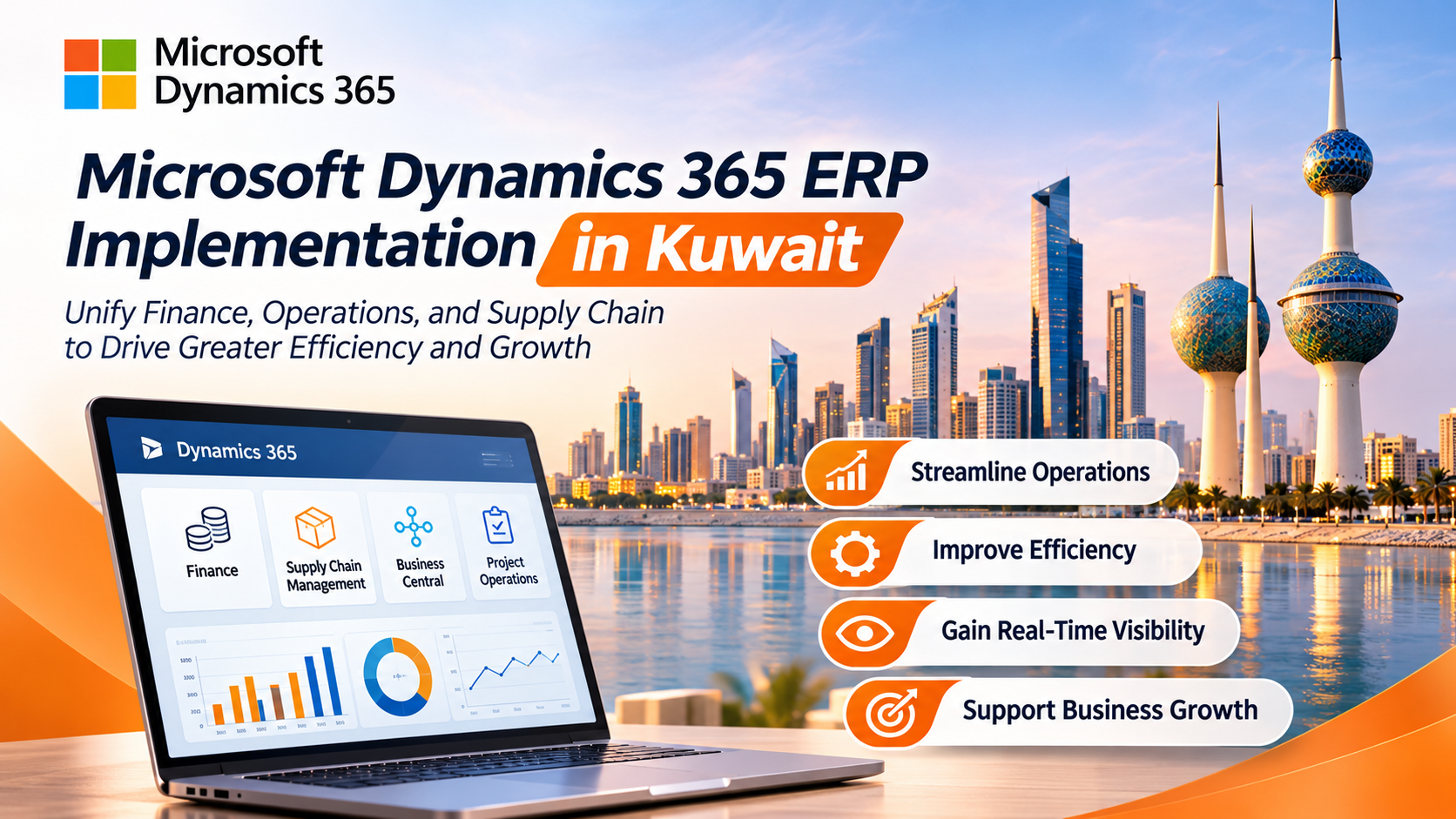
The platform includes several ERP applications, each designed for particular business requirements. The most relevant options to consider include Dynamics 365 Finance, Supply Chain Management, Business Central, and Project Operations.
Top Microsoft Dynamics 365 ERP Solutions for Businesses in Kuwait
Choosing an ERP application should start with the organisation’s size, operational structure, and business priorities. A company looking to centralise accounting and purchasing may need a different solution from a large group managing complex supply chains or project-based operations.
The following Dynamics 365 applications address different requirements.
1. Microsoft Dynamics 365 Finance
For organisations with complex financial structures and multi-entity operations
Microsoft Dynamics 365 Finance is designed to help medium-sized and large organisations manage financial operations with greater control and consistency.
Its capabilities include general ledger management, accounts payable and receivable, budgeting, cash and bank management, financial reporting, and financial planning.
For Kuwaiti companies operating through multiple subsidiaries, business units, or regional branches, the application can help centralise financial information and support more consistent reporting across the organisation.
It can also be relevant for businesses dealing with international suppliers, foreign-currency transactions, intercompany activity, and group-level financial consolidation.
During implementation, finance teams should define the appropriate accounting structures, reporting requirements, approval workflows, and applicable tax treatments for each legal entity.
2. Microsoft Dynamics 365 Supply Chain Management
For businesses managing procurement, inventory, warehousing, and production
Microsoft Dynamics 365 Supply Chain Management helps organisations coordinate activities across procurement, inventory, warehousing, manufacturing, and distribution.
For Kuwait’s trading, retail, industrial, and distribution businesses, managing stock accurately is essential. Companies may deal with international sourcing, imported products, multiple storage locations, and supplier lead times that influence purchasing and fulfilment decisions.
Supply Chain Management provides capabilities for inventory visibility, demand planning, purchasing, warehouse operations, production planning, and order fulfilment.
It can help businesses improve control over stock movements, monitor procurement activities, and coordinate the flow of goods from suppliers to warehouses and customers.
For organisations operating across several locations, implementation should consider warehouse structures, product data, purchasing policies, replenishment rules, and integration with finance and sales processes.
3. Microsoft Dynamics 365 Business Central
For small and medium-sized businesses seeking integrated business management
Microsoft Dynamics 365 Business Central provides an integrated business management solution for small and medium-sized organisations.
It brings together financial management, sales, purchasing, inventory, project costing, and other core business processes in one platform.
For growing Kuwaiti businesses that have outgrown spreadsheets or separate accounting and inventory applications, Business Central can provide a more structured way to manage everyday operations.
It is particularly relevant for trading companies, service providers, smaller distributors, and businesses that need better financial and operational visibility without the complexity of a large enterprise ERP environment.
The application also supports reporting, Microsoft 365 integration, and multi-currency business operations. Its suitability should be assessed against the company’s transaction volumes, operational complexity, and future expansion plans.
Microsoft Dynamics 365
4. Microsoft Dynamics 365 Project Operations
For engineering, construction, consulting, and project-based businesses
Microsoft Dynamics 365 Project Operations helps organisations manage the commercial and operational side of project delivery.
It connects sales activities, resource planning, project management, and financial processes, allowing businesses to follow projects from the initial opportunity through execution and financial review.
This can be valuable for Kuwaiti engineering companies, contractors, professional services firms, and organisations delivering projects with defined budgets, timelines, resources, and customer contracts.
Project Operations can support project planning, resource allocation, time and expense tracking, project costing, and profitability analysis.
For businesses managing several projects simultaneously, the solution can provide a clearer picture of resource utilisation, project costs, and financial performance.
Microsoft Learn+1
How to Choose the Right Dynamics 365 ERP Solution in Kuwait
Selecting an ERP system should be based on the processes the business needs to improve, rather than choosing an application simply because it offers the largest number of features.
Before making a decision, organisations should consider the following:
Business size and operational complexity
A growing company with straightforward financial and inventory requirements may find Business Central suitable. A large group with complex financial structures, extensive procurement activities, or multiple warehouses may require Dynamics 365 Finance and Supply Chain Management.
Industry-specific requirements
Trading, retail, manufacturing, construction, and professional services businesses have different operational priorities. The ERP design should reflect the organisation’s actual workflows, reporting needs, and industry requirements.
Multi-company and regional operations
Companies operating through multiple legal entities or across GCC markets should assess how the solution will handle intercompany transactions, currency management, consolidated reporting, and shared business processes.
Integration with existing systems
An ERP platform should fit into the wider technology environment. Businesses may need connections with banking platforms, warehouse systems, point-of-sale applications, e-commerce platforms, CRM solutions, or existing business applications.
Long-term scalability
The chosen solution should support the organisation’s future direction, whether that means opening additional branches, expanding into new markets, increasing warehouse capacity, or introducing new business activities.
Key Benefits of Implementing Microsoft Dynamics 365 ERP in Kuwait
A properly planned implementation can create improvements across several business functions.
1. Centralised Financial Information
Bringing financial transactions and reporting into a connected environment helps management access more consistent information and reduces dependence on manually consolidated departmental reports.
2. Better Control Over Procurement and Inventory
Connecting purchasing, supplier information, and stock movements gives businesses improved visibility into inventory levels and procurement activities.
3. More Consistent Processes Across Branches
Companies with multiple locations can establish standard workflows and approval procedures while maintaining the visibility needed to manage individual branches or business units.
4. Improved Management Reporting
Connected business data can support more timely financial and operational reporting, helping decision-makers identify performance issues and review business priorities.
5. Stronger Coordination Between Departments
When finance, procurement, sales, warehouse, and project teams work with connected information, employees can reduce repetitive data entry and improve coordination across business processes.
6. More Structured Project Cost Management
Project-oriented organisations can monitor budgets, resource utilisation, costs, and project financial performance more effectively when project operations are connected with financial management.
7. Support for Regional Business Expansion
Multi-currency capabilities, intercompany processes, and consolidated reporting can help organisations manage more complex regional operations as their business grows.
These benefits depend on selecting the appropriate applications, configuring them correctly, and ensuring that employees consistently use the implemented processes.
Important Considerations Before ERP Implementation in Kuwait
Even a capable ERP platform can fall short if the implementation does not account for the organisation’s local requirements and operating environment. Businesses should address several areas before moving forward.
1. Understand Local Financial and Tax Requirements
ERP configuration should reflect the company’s legal structure and applicable financial obligations in Kuwait.
For example, tax treatment and filing requirements can differ depending on the nature of the business and its ownership structure. Companies subject to Kuwait corporate tax or other applicable obligations should ensure their accounting configuration supports the necessary records, calculations, reporting, and audit requirements.
PwC’s Kuwait tax guidance highlights requirements such as maintaining accounting records in Kuwait and submitting tax returns within the prescribed filing period. These requirements should be reviewed with qualified local tax advisers before the ERP design is finalised.
Tax administration+1
2. Review Payroll and Employee Administration
Businesses should identify how employee records, payroll processes, leave, attendance, and end-of-service calculations are currently managed.
If payroll or HR functionality is required, the implementation team should confirm whether the selected Dynamics 365 applications, available local extensions, or connected HR solutions can support the company’s specific requirements.
Local employment and social security requirements should be validated rather than assumed to be covered by standard ERP functionality.
3. Prepare for Multi-Currency and Multi-Entity Operations
Many Kuwaiti businesses purchase products and services from international suppliers or operate through regional entities.
The ERP design should account for foreign-currency transactions, exchange-rate handling, intercompany accounting, and consolidated financial reporting where relevant.
These requirements should be defined early to avoid complex adjustments after the system goes live.
4. Plan Banking and Third-Party Integrations
Finance teams may need the ERP to exchange information with local banks, payment services, external reporting platforms, or other operational applications.
The implementation should define which systems need to communicate, what information must be exchanged, how frequently synchronisation should occur, and how errors will be handled.
Integration requirements should be tested with the relevant providers before go-live.
5. Clean and Organise Existing Business Data
Data migration is one of the most important parts of an ERP project.
Before transferring information, businesses should review their existing customer and supplier records, product catalogues, inventory balances, chart of accounts, open transactions, and historical information.
Duplicated records, inconsistent product codes, and incomplete financial data can affect the reliability of the new system if they are transferred without proper preparation.
6. Select an Experienced Implementation Partner
ERP implementation involves more than technical configuration. It requires business analysis, process design, data migration, integration, testing, training, and ongoing support.
Businesses should assess a partner’s experience with the selected Dynamics 365 applications, industry requirements, local business environment, and similar implementation projects.
The partner should also provide a clear project plan, defined responsibilities, realistic milestones, and a structured approach to post-launch support.
7. Invest in Employee Training and Adoption
Employees need to understand how their daily responsibilities will change once the ERP system is introduced.
Training should be tailored to each department, using realistic business scenarios rather than focusing only on software features.
Involving key users during process design and testing can also help identify practical issues before the system becomes operational.
Microsoft Dynamics 365 ERP Implementation Examples in Kuwait
Businesses in Kuwait can look at existing regional and local implementations to understand how Microsoft business applications can support different operating models.
Fawaz Trading & Engineering Services
Microsoft published a case study on Fawaz Trading & Engineering Services, an engineering and trading company with operations across Kuwait and other GCC markets.
The company adopted Dynamics 365 Finance and Operations to bring financial and operational information together across countries. The implementation covered inventory, procurement, sales, finance, and project activities, helping the organisation improve inventory management, project-cost visibility, and financial consolidation.
The case study reports that the solution was used by more than 190 employees across Kuwait, the UAE, Bahrain, Qatar, Oman, and Saudi Arabia.
cdn.featuredcustomers.com+1
Bon Group
Bon Group, a Kuwait-based food retail business, adopted Dynamics 365 Business Central as part of a broader effort to centralise its back-office operations while expanding its retail branches.
The project connected finance, HR, and payroll processes and formed part of a phased move towards a cloud-based technology environment. The case study highlights the value of centralised information and more structured administrative processes as the business grows.
casestudies.com+1
These examples demonstrate that ERP requirements differ considerably between organisations. A multi-country engineering and trading company may prioritise financial consolidation and project cost management, while a growing retail business may focus on centralised finance and back-office processes.
Conclusion
Implementing Microsoft Dynamics 365 ERP in Kuwait can help businesses move away from disconnected applications and manual processes towards a more integrated way of managing finance, procurement, inventory, projects, and daily operations.
The right solution depends on the organisation’s size, industry, current systems, and future plans. Business Central may suit growing companies looking to centralise core operations, while Dynamics 365 Finance and Supply Chain Management can address more complex enterprise requirements. Project Operations is particularly relevant for organisations managing project-based services and delivery.
However, successful implementation depends on more than selecting the right software. Understanding local financial requirements, preparing business data, designing appropriate workflows, integrating existing systems, and supporting employees throughout the transition are all essential.
With the right implementation strategy and partner, Microsoft Dynamics 365 can provide Kuwaiti businesses with a stronger operational foundation, better management visibility, and the flexibility to support future growth.
Looking to implement Microsoft Dynamics 365 ERP in Kuwait?
BI-Technologies helps businesses explore Microsoft business solutions and identify the ERP approach that best fits their operational requirements.