


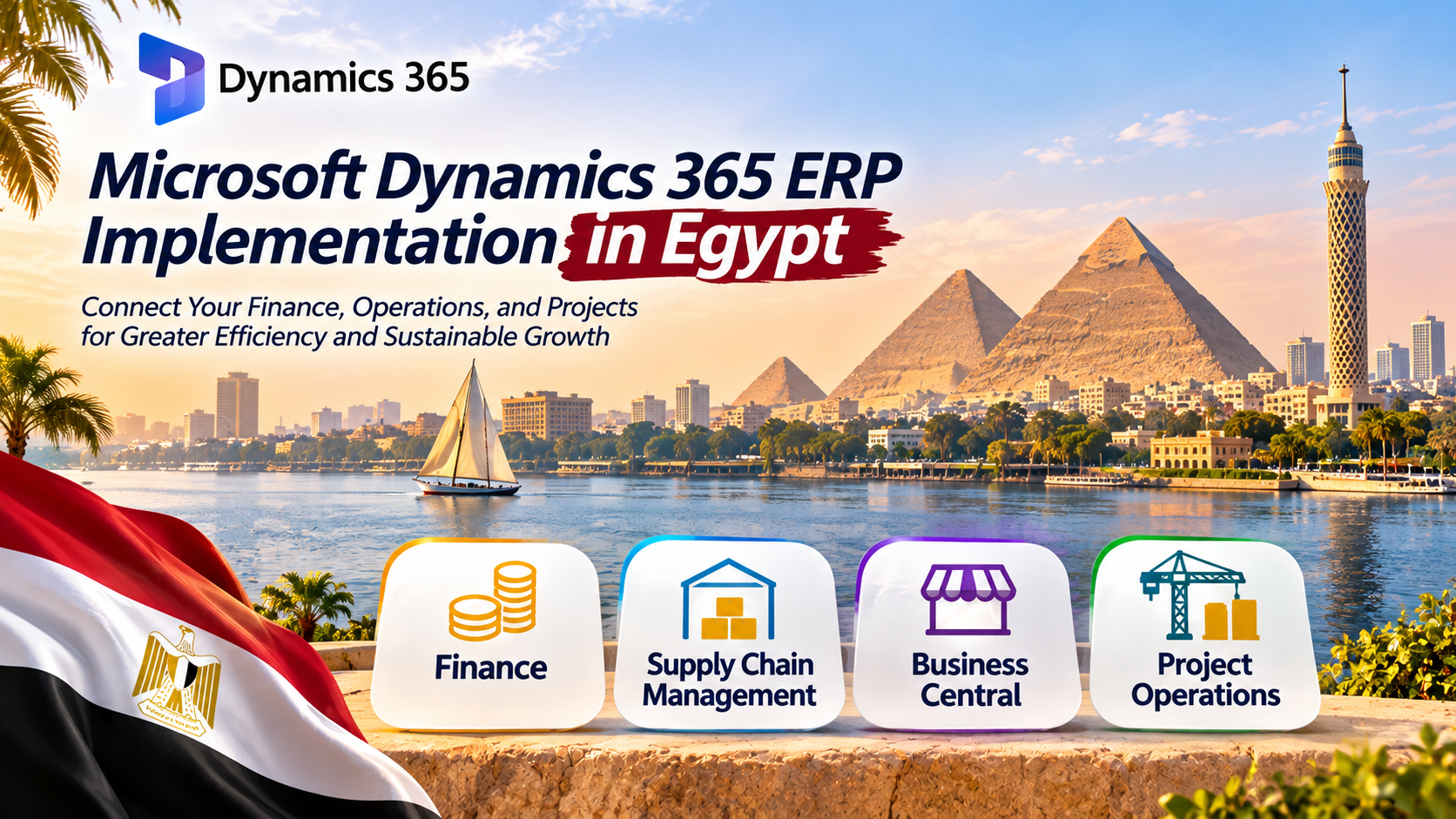
The right ERP application depends on the organisation’s size, industry, and the level of operational control it needs. A growing distributor may prioritise accounting and stock management, while a large manufacturer may require advanced procurement, production planning, and warehouse capabilities. Businesses managing construction contracts or professional services may need stronger project-cost and resource management.
Microsoft Dynamics 365 offers several applications that can be selected individually or combined to support these different business models.
1. Microsoft Dynamics 365 Finance
For organisations managing complex accounting and financial operations
Microsoft Dynamics 365 Finance helps businesses manage general ledger, accounts payable and receivable, budgeting, cash flow, financial planning, and financial reporting.
For Egyptian organisations operating through several branches, subsidiaries, or business units, the application can support more consistent accounting procedures and give management a clearer view of financial performance.
It is particularly relevant to companies handling high transaction volumes, international supplier payments, multiple currencies, and detailed financial reporting requirements.
One important consideration for Egyptian implementations is the availability of country-specific financial reporting configurations. Microsoft documents support for Egypt-related VAT declarations, withholding tax declarations, registration numbers, and invoice layouts in Dynamics 365 Finance. These features need to be configured according to the legal entity’s requirements and the applicable reporting process.
Microsoft Learn+2
2. Microsoft Dynamics 365 Supply Chain Management
For companies managing procurement, inventory, warehousing, and manufacturing
Microsoft Dynamics 365 Supply Chain Management helps organisations coordinate the movement of materials and products across suppliers, warehouses, production facilities, and customers.
This application can be valuable for Egyptian manufacturers, FMCG companies, distributors, retailers, and importers managing large product portfolios or multiple storage locations.
Its capabilities cover procurement, inventory management, warehouse operations, demand planning, production planning, and order fulfilment.
For companies dealing with imported raw materials, local suppliers, changing purchasing costs, or distribution across several governorates, connected supply chain processes can improve visibility over stock and purchasing commitments.
Implementation should consider warehouse structures, product and supplier records, inventory valuation, replenishment policies, and the connection between purchasing, production, sales, and finance.
3. Microsoft Dynamics 365 Business Central
For small and medium-sized businesses looking to connect everyday operations
Microsoft Dynamics 365 Business Central provides an integrated business management platform for organisations that want to bring essential activities together.
It supports financial management, sales, purchasing, inventory, project costing, and reporting. For growing Egyptian companies that have outgrown spreadsheets or separate accounting and stock applications, Business Central can provide a more structured way to manage daily transactions.
It may suit trading companies, smaller distributors, service providers, and growing businesses that need better control over their financial and operational information without the complexity of a large enterprise ERP environment.
The solution can also connect with Microsoft 365 applications and be extended through additional applications where required. However, companies should verify the availability and suitability of Egyptian tax and e-invoicing extensions before selecting Business Central for local statutory processes.
Microsoft Dynamics 365+1
4. Microsoft Dynamics 365 Project Operations
For construction, engineering, consulting, and project-based organisations
Microsoft Dynamics 365 Project Operations helps organisations manage the commercial and operational activities involved in delivering projects.
It connects project planning, sales, resource management, time and expense tracking, project costing, and financial processes.
This can be relevant to Egyptian contractors, engineering firms, consulting companies, and professional services providers managing multiple projects with different budgets, delivery schedules, and resource requirements.
The application helps businesses monitor project progress and review the relationship between planned costs, actual expenses, resource utilisation, and financial performance.
For organisations managing several contracts simultaneously, a more structured project environment can improve cost visibility and help management identify potential issues before they affect delivery.
How to Choose the Right Dynamics 365 ERP Solution in Egypt
Selecting an ERP platform should begin with a clear understanding of the organisation’s operating model and business priorities. Before making a decision, Egyptian companies should assess the following factors.
Business size and transaction complexity
A growing company with relatively straightforward accounting, sales, and inventory requirements may find Business Central suitable. Larger organisations with several legal entities, complex procurement, or extensive warehouse operations may require Dynamics 365 Finance and Supply Chain Management.
Industry-specific processes
Manufacturers, distributors, retailers, contractors, and service providers have different requirements. The chosen solution should reflect the company’s actual workflows, whether those involve production planning, stock replenishment, branch management, or project-cost control.
Egyptian tax and invoicing requirements
Businesses should understand how the proposed ERP configuration will support VAT reporting, withholding tax, electronic invoicing, electronic receipts where applicable, and other relevant obligations. These requirements should be assessed before the solution design is finalised.
Multiple branches and regional operations
Companies operating across Cairo, Alexandria, the Delta, Upper Egypt, or other markets may need consistent reporting across branches and warehouses. Businesses with regional subsidiaries should also assess multi-currency and intercompany requirements.
Integration with existing systems
An ERP platform may need to exchange information with banks, HR and payroll applications, warehouse systems, point-of-sale solutions, CRM platforms, or the Egyptian Tax Authority’s electronic systems. Integration requirements should be documented and technically validated before implementation.
Scalability and future expansion
The selected solution should support realistic growth plans, including additional branches, warehouses, product lines, legal entities, and increased transaction volumes.
Key Benefits of Implementing Microsoft Dynamics 365 ERP in Egypt
When the right applications are configured around the organisation’s requirements, ERP implementation can improve how departments share information, manage resources, and monitor business performance.
1. Bring Financial Operations Under Better Control
Connecting financial transactions and reporting in one environment helps management review income, expenses, cash positions, and outstanding balances through more consistent information.
Finance teams can reduce manual consolidation and establish clearer procedures for accounting, budgeting, approvals, and period-end reporting.
2. Improve Procurement and Supplier Management
A connected purchasing process helps businesses monitor supplier records, purchase orders, approvals, and procurement commitments.
This is especially useful for companies that depend on imported materials, local suppliers, or recurring purchases across several business units. Better visibility can help procurement teams review spending and coordinate purchasing decisions with operational needs.
3. Strengthen Inventory and Warehouse Visibility
Businesses can monitor stock across different warehouses and storage locations, review inventory movements, and coordinate replenishment with purchasing and sales teams.
For manufacturers, distributors, and retailers operating across several governorates, better inventory information can help reduce avoidable shortages and improve stock planning.
4. Standardise Processes Across Branches and Departments
Companies with multiple branches or business units can establish common procedures for purchasing, approvals, financial transactions, and reporting.
This helps management maintain an overall view of the organisation while still reviewing the performance of individual locations and departments.
5. Improve Production and Supply Chain Planning
Manufacturers can connect production requirements with raw material availability, purchasing activities, and inventory information.
This can help teams plan production more effectively, identify material shortages, and improve coordination between procurement, warehouse, and manufacturing functions.
6. Monitor Project Budgets and Costs More Effectively
For construction, engineering, and project-based organisations, connecting project activities with financial information can help managers review budgets, expenses, resource utilisation, and profitability.
More structured project information can also support better control over commitments and changes during project execution.
7. Support Faster and More Informed Business Decisions
Connected financial and operational data gives management a broader view of business performance. Reporting tools and dashboards can help identify issues, compare results, and review operational priorities using more reliable information.
These outcomes depend on the selected applications, implementation quality, data accuracy, and employee adoption.
Important Considerations Before ERP Implementation in Egypt
A successful ERP project must account for Egypt’s financial and regulatory environment, the organisation’s existing systems, and the practical requirements of its employees. The following areas should be addressed before implementation begins.
1. Plan for Egyptian E-Invoicing and E-Receipt Requirements
The Egyptian Tax Authority’s electronic invoicing and electronic receipt systems are important considerations when designing finance and sales processes.
The e-invoicing system applies to business-to-business transactions, while the e-receipt system covers relevant business-to-consumer transactions. Businesses should determine which obligations apply to their activities and confirm their registration and integration requirements with the Tax Authority.
مصلحة الضرائب المصرية+2
Microsoft provides Egypt-specific electronic invoicing guidance for Dynamics 365 Finance and Supply Chain Management. Its documentation describes the configuration required to generate electronic invoices in the Egyptian format and submit them to the Tax Authority through the Electronic Invoicing feature.
Microsoft Learn+1
Before implementation, companies should validate:
-
Taxpayer registration and required electronic signatures.
-
Product and service coding requirements.
-
Invoice and credit-note formats.
-
Electronic document submission and status tracking.
-
Integration with the Tax Authority’s platform.
-
Handling of rejected, amended, or cancelled documents.
The implementation team should test the complete invoicing process before go-live. Companies using Business Central or another ERP application should separately confirm the availability and reliability of the required local integration or extension rather than assume that the same configuration applies across all Dynamics 365 products.
2. Configure VAT and Withholding Tax Processes
Egyptian businesses need to maintain appropriate tax records and prepare the required declarations and reports.
Microsoft’s Dynamics 365 Finance documentation includes Egypt-specific configurations for VAT declarations and withholding tax reporting. It describes VAT return form No. 10 and related sales and purchase transaction reports, as well as withholding tax forms No. 41 and No. 11 for relevant transactions.
GitHub+1
However, generating a report in the ERP does not necessarily mean that the tax return is automatically filed with the Tax Authority. The filing workflow and any required portal submission should be confirmed with the company’s tax advisers.
3. Review Accounting Structures and Financial Reporting
Before configuring the system, finance teams should review the chart of accounts, financial dimensions, cost centres, branch structures, approval workflows, and reporting requirements.
Businesses operating through multiple legal entities should also define intercompany processes and consolidated reporting requirements.
This preparation helps ensure that the new system reflects how the organisation manages its finances rather than simply reproducing the limitations of its previous applications.
4. Define Multi-Currency and Import-Related Requirements
Companies purchasing goods or materials from international suppliers may need to manage foreign-currency transactions, exchange-rate differences, import costs, and supplier payment schedules.
The ERP design should establish how currencies are recorded, how exchange rates are maintained, and how landed costs or other relevant purchasing expenses are allocated.
These requirements are particularly important for importers, manufacturers, and distributors whose operating costs are affected by international sourcing.
5. Prepare Data Across Branches and Warehouses
Many organisations maintain customer, supplier, product, and inventory information across separate systems or spreadsheets.
Before migration, businesses should review customer and supplier records, product codes, units of measure, warehouse balances, financial accounts, open invoices, purchase orders, and historical transactions.
Duplicated records and inconsistent information should be corrected before data is transferred. This helps protect the accuracy of reporting and reduces disruption after the new system goes live.
6. Assess Existing Systems and Integration Requirements
An ERP project should consider the wider technology environment, not just the software being replaced.
Businesses may need connections with banking platforms, payroll systems, point-of-sale applications, warehouse management tools, CRM platforms, or the Egyptian Tax Authority’s electronic systems.
The implementation team should document what information needs to move between systems, how frequently it should be exchanged, and how failed transactions will be handled.
7. Select an Experienced Implementation Partner and Train Employees
ERP implementation involves business analysis, solution design, configuration, data migration, integration, testing, training, and ongoing support.
Companies should assess the partner’s experience with the selected Dynamics 365 applications, Egyptian tax and invoicing requirements, industry processes, and similar implementation projects.
Employee training should also be planned from the beginning. Finance, procurement, warehouse, sales, and project teams need role-specific guidance so they understand how the new system changes their daily responsibilities.
Microsoft Dynamics 365 ERP Implementation Examples in Egypt
Looking at examples from the Egyptian market can help businesses understand how different Dynamics 365 applications may support specific industries and operational requirements.
Abdullah Al-Othaim Markets Egypt – Retail Operations
PROART, a Microsoft Solutions Partner, shared an implementation announcement describing Abdullah Al-Othaim Markets Egypt’s use of Microsoft Dynamics 365 to improve retail operations.
The published overview highlights inventory optimisation, replenishment, warehouse management, supplier-related processes, e-invoicing, and supply chain integration. These areas are particularly relevant to supermarket businesses managing multiple stores, suppliers, and large product assortments.
Microsoft Solutions Partner+1
Organo – Manufacturing and Agribusiness
CompactSoft, a Microsoft Solutions Partner, describes its implementation of Dynamics 365 Business Central for Organo, an agribusiness involved in animal feed manufacturing and poultry production.
The project connected raw material procurement, production activities, inventory, and finance. The business previously faced fragmented information across its operations, making it harder to coordinate purchasing, manufacturing, and financial records.
The published case study highlights the value of bringing these processes into one platform and improving visibility across connected business activities.
compactsoft+1
These examples illustrate how ERP requirements differ by industry. A supermarket chain may prioritise store operations, replenishment, and warehouse coordination, while a manufacturer needs closer control over raw materials, production planning, and financial performance.
These examples are based on implementation announcements published by the respective solution partners, rather than independently audited performance reports.
Egypt’s Business and Digital Transformation Context
Egypt’s business environment makes connected financial and operational systems increasingly relevant, particularly for organisations managing large transaction volumes and changing regulatory requirements.
Expansion of Electronic Tax Processes
The Egyptian Tax Authority has developed electronic invoicing and electronic receipt systems, supported by registration procedures, taxpayer guidance, integration documentation, and technical resources.
For businesses implementing ERP, this means invoicing and tax-system connectivity should be treated as part of the overall solution design rather than as an administrative task after go-live.
مصلحة الضرائب المصرية+2
More Structured Financial Reporting
Microsoft’s Egypt-specific Dynamics 365 Finance documentation covers VAT declarations, withholding tax reporting, invoice layouts, and registration information. This provides a useful starting point for organisations assessing how their ERP configuration can support Egyptian financial processes.
Microsoft Learn+2
Connecting Operations Across Multiple Locations
Manufacturers, distributors, and retailers may manage activities across several governorates, branches, warehouses, and supplier networks. An integrated ERP environment can help bring these processes together and give management more consistent information for operational planning.
These developments reinforce the importance of choosing an ERP solution that addresses both current business requirements and the organisation’s ability to adapt to future changes.
Conclusion
Implementing Microsoft Dynamics 365 ERP in Egypt can help organisations improve the way they manage finance, procurement, inventory, manufacturing, and project-related activities.
The appropriate solution depends on the company’s size, industry, existing systems, and growth plans. Business Central may suit growing businesses seeking integrated core management, while Dynamics 365 Finance and Supply Chain Management can address more complex enterprise requirements. Project Operations can provide additional capabilities for organisations managing project-based work.
However, successful implementation requires more than choosing the right application. Businesses must also prepare for Egyptian e-invoicing and e-receipt requirements, configure tax reporting correctly, organise existing data, plan integrations, and train employees to work effectively with the new system.
With a clear implementation strategy and an experienced partner, Microsoft Dynamics 365 can help Egyptian companies establish stronger operational control, improve management visibility, and build a technology foundation that supports sustainable growth.
Planning to implement Microsoft Dynamics 365 ERP in Egypt?
BI-Technologies can help assess your business requirements and explore the Microsoft business solutions that best fit your organisation.