


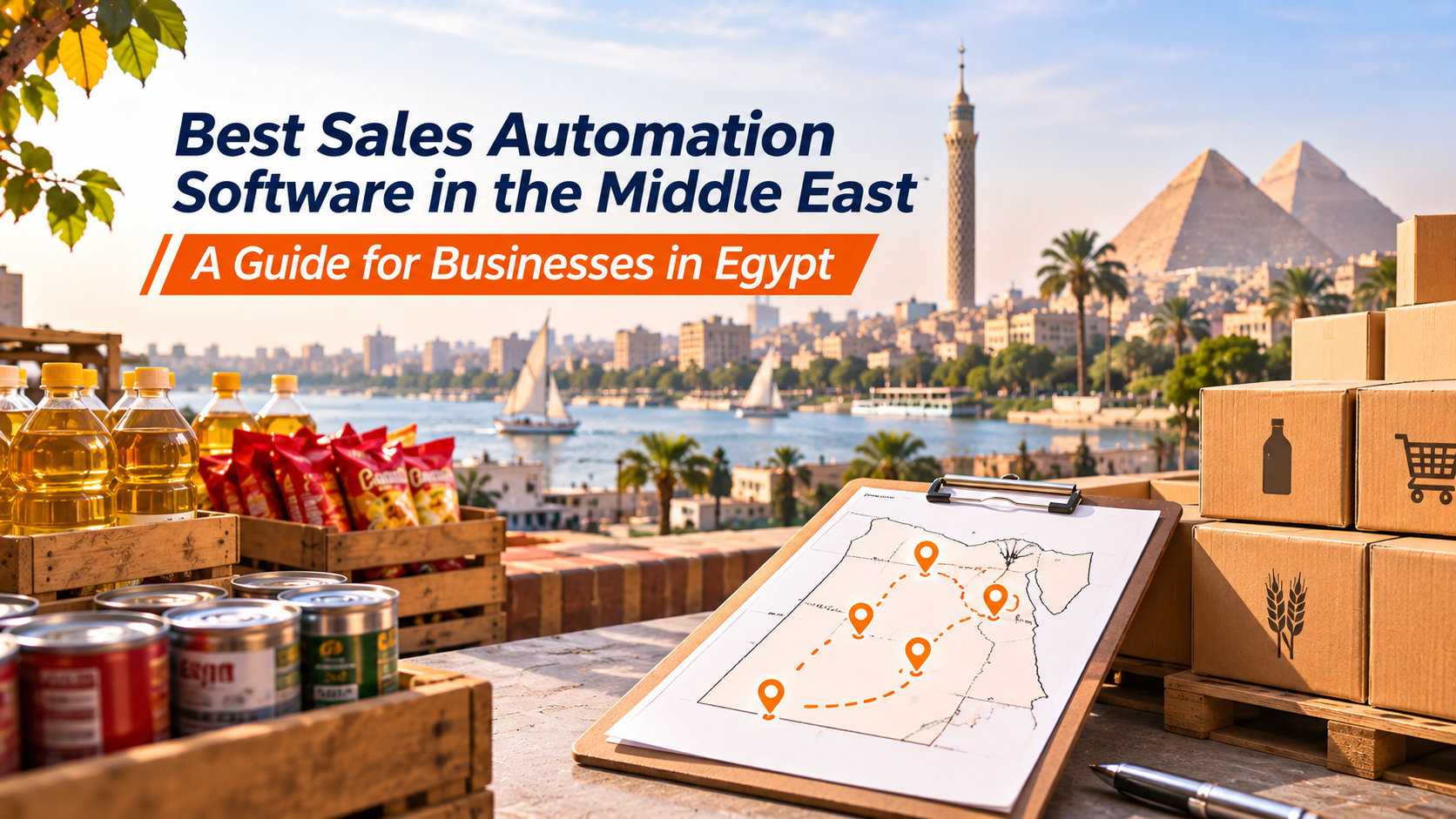
Egypt’s sales and distribution sector operates across a diverse commercial landscape. FMCG manufacturers, wholesalers, importers, and distributors must serve customers ranging from small neighbourhood grocery stores to large supermarket chains, while coordinating sales representatives, warehouses, and delivery operations.
As customer networks expand, maintaining control over daily sales activities becomes increasingly challenging. Businesses may struggle to track representative visits, follow up on customer orders, identify product shortages, or understand which territories are generating the strongest results. When this information is spread across spreadsheets, paper documents, and disconnected applications, management visibility becomes limited.
Sales automation software helps companies organise these activities through connected digital processes. It can support customer management, field visits, mobile order collection, route planning, merchandising, payment follow-up, and sales performance reporting.
However, choosing the right solution requires understanding the company’s sales model. A business managing corporate accounts may need a different set of capabilities from an FMCG distributor whose representatives visit dozens of retail outlets every day.
This guide explores the main types of sales automation software available to businesses in Egypt, explains the capabilities worth evaluating, and highlights how an integrated field-sales platform such as SalesBuzz can support organisations operating in the Egyptian market.
What Is Sales Automation Software?
Sales automation software uses technology to organise and simplify the activities involved in managing customers, generating orders, following up on opportunities, and measuring commercial performance.
Instead of depending on manual records and separate applications, businesses can manage customer information, assign sales responsibilities, capture transactions, and monitor team performance through a more connected environment.
Sales automation generally covers four main solution categories:
-
Customer Relationship Management (CRM): Organises customer profiles, leads, business opportunities, quotations, and communication records.
-
Sales Force Automation (SFA): Supports field representatives with customer visits, route planning, GPS tracking, mobile orders, and sales targets.
-
FMCG and Distribution Automation: Addresses the needs of consumer goods businesses through van sales, merchandising, inventory coordination, dispatch, delivery, and collections.
-
Integrated Sales and ERP Solutions: Connects sales activities with financial management, inventory, procurement, warehousing, and other business functions.
These categories can overlap, but they are not interchangeable. A company selling services to corporate clients may prioritise customer relationship management, while a distributor supplying hundreds of grocery stores may require specialist field-sales and distribution capabilities.
Understanding these differences is the first step towards selecting software that genuinely supports the business.
Types of Sales Automation Solutions Available in Egypt
Businesses looking for sales automation software should first identify the type of solution that matches their operational requirements.
1. CRM-Focused Sales Automation Solutions
For companies prioritising customer relationships and sales opportunities
CRM-focused solutions help businesses maintain customer information and manage the commercial journey from an initial enquiry to a completed sale.
Typical capabilities include:
-
Lead and contact management.
-
Customer account records.
-
Opportunity tracking.
-
Sales pipeline management.
-
Follow-up reminders and task assignment.
-
Quotation management.
-
Sales forecasting and reporting.
These solutions can be suitable for Egyptian companies operating in B2B services, professional services, technology, and corporate sales environments.
They are particularly useful when sales teams manage a relatively structured pipeline of prospects and existing accounts.
However, businesses with large mobile sales teams should check whether the selected platform also supports field activities such as GPS tracking, outlet visits, route planning, and mobile order collection.
2. Field Sales Automation (SFA) Solutions
For organisations managing representatives who work outside the office
SFA solutions focus on the daily activities of field representatives and their supervisors.
They help companies organise customer visits, monitor sales coverage, capture orders, and evaluate field performance.
Common features include:
-
Mobile customer information and purchase history.
-
Visit scheduling and tracking.
-
GPS monitoring.
-
Territory and route management.
-
Mobile order collection.
-
Sales targets and performance indicators.
-
Field activity reporting.
For businesses operating across Cairo, Giza, Alexandria, the Delta, and Upper Egypt, these capabilities can help managers coordinate representatives across different territories.
SFA is especially relevant to companies that depend on frequent customer visits and need better visibility into what happens outside the office.
3. FMCG and Distribution Automation Solutions
For manufacturers, wholesalers, and distributors managing physical products
FMCG and distribution automation solutions address operational requirements that go beyond conventional customer relationship management.
They help businesses coordinate sales representatives with warehouses, delivery teams, and distribution processes.
Typical capabilities include:
-
Pre-sales and van sales.
-
Customer order capture.
-
Product and stock availability checks.
-
Retail merchandising.
-
Route and journey planning.
-
Delivery coordination.
-
Customer collections.
-
Outstanding invoice monitoring.
-
Sales performance dashboards.
These solutions are particularly relevant to Egyptian businesses distributing food and beverages, dairy products, snacks, personal care products, household goods, and other consumer products.
They can also help companies manage different customer channels, including traditional grocery stores, supermarkets, wholesalers, and institutional buyers.
4. Integrated Sales and ERP Solutions
For businesses seeking connected commercial and operational processes
Some organisations need sales automation to work alongside their wider enterprise systems.
An integrated environment can connect customer orders and field activities with inventory, procurement, finance, warehouse management, and delivery operations.
For example, a sales representative may capture a customer order in the field, while the back office uses connected business applications to review stock availability, process the order, prepare invoicing, and coordinate fulfilment.
This approach can be valuable for larger distributors and manufacturers that want to reduce information gaps between departments.
The level of integration depends on the selected applications, technical design, and implementation scope.
Comparing the Main Types of Sales Automation Solutions
Each solution category addresses a different part of the sales operation.
| Solution type | Most suitable for | Main capabilities |
|---|---|---|
| CRM Automation | B2B and relationship-based sales | Customer records, leads, opportunities, follow-ups |
| Field Sales Automation | Mobile sales teams | Visits, GPS, routes, orders, sales targets |
| FMCG and Distribution Automation | Manufacturers and distributors | Van sales, merchandising, inventory coordination, collections |
| Integrated Sales and ERP | Businesses with connected operational requirements | Sales, finance, inventory, procurement, delivery |
This comparison is intended to explain the different solution types rather than rank individual products. Businesses should evaluate their operational requirements before deciding which category or combination of applications is appropriate.
How to Choose the Right Sales Automation Software in Egypt
The selection process should begin with an assessment of the company’s sales structure, customer channels, and operational challenges.
The following considerations can help Egyptian businesses make a more informed decision.
1. Understand Your Sales Process
Start by identifying how the business acquires customers, assigns accounts, processes orders, and manages follow-up activities.
A company selling to corporate clients may need opportunity tracking and quotation management. An FMCG distributor may require mobile order collection, outlet visits, route planning, and merchandising.
The software should support the actual workflow of the business rather than introduce unnecessary procedures.
2. Consider Egypt’s Different Retail Channels
Egypt’s retail market includes neighbourhood grocery stores, traditional retailers, supermarkets, hypermarkets, wholesalers, and online channels.
The USDA’s 2026 Egypt Retail Foods Annual highlights the continued importance of small local grocers, which account for close to two-thirds of food retail sales by value. It also identifies opportunities across modern retail channels.
USDA Foreign Agricultural Service
A suitable platform should allow businesses to classify customers by channel, location, account value, and service requirements.
3. Evaluate Mobile Capabilities for Field Representatives
Representatives need convenient access to customer records, product catalogues, prices, previous orders, and sales targets while visiting customers.
Check whether the mobile application makes it easy to record visits, capture orders, update customer information, and submit field reports.
Offline functionality and data synchronisation should also be considered for representatives operating in areas where connectivity may vary.
4. Review Territory Allocation and Route Planning
Companies serving customers across multiple governorates need an organised way to assign outlets and monitor representative activity.
Look for tools that support route scheduling, GPS monitoring, visit verification, territory allocation, and missed-visit reporting.
These capabilities can help improve field coverage and make better use of sales resources.
5. Check Integration with ERP and Inventory Systems
Sales automation should connect with the company’s wider operations where required.
Customer orders may need to move between the sales platform, ERP, inventory, warehouse, invoicing, and delivery applications.
Before selecting a solution, document the information that needs to be exchanged and confirm whether the required integrations are available or involve additional development.
6. Examine Reporting and Performance Measurement
Managers need information that explains more than total monthly sales.
The platform should support reporting on customer coverage, visit completion, order frequency, representative productivity, sales targets, product performance, and geographical results.
This helps management identify problems and make decisions based on more complete information.
7. Assess Implementation and Long-Term Support
The total investment includes more than software licensing. Companies should consider configuration, data migration, integrations, employee training, technical support, and future upgrades.
For Egyptian businesses, it is also important to assess Arabic and English requirements, hosting arrangements, local implementation experience, and the availability of ongoing assistance.
Business Benefits of Sales Automation for Companies in Egypt
When implemented around the company’s sales model, automation can improve the way businesses manage customers, supervise field teams, and coordinate distribution activities.
1. Gain Better Control Over Customer Accounts
Distributors often maintain large customer databases covering neighbourhood shops, traditional retailers, supermarkets, wholesalers, and institutional buyers.
A central platform helps organise these accounts, assign representatives, and maintain records of customer visits, orders, and follow-up activities.
This makes it easier to identify inactive accounts and improve customer coverage.
2. Organise Sales Territories Across Different Governorates
Managing representatives across several geographical areas requires clear territory assignments and customer responsibilities.
Sales automation can help companies divide their markets into manageable territories, allocate outlets to representatives, and compare activity across locations.
Managers gain a clearer picture of where sales coverage is strong and where additional resources may be required.
3. Improve the Productivity of Daily Field Visits
Representatives need to balance customer interactions with the time spent travelling between outlets.
Route-planning tools can organise daily journeys according to customer locations and visit priorities. GPS tracking and visit records provide supervisors with more information about actual field activity.
This can help reduce unnecessary travel and improve the use of working hours.
4. Make Customer Order Collection More Efficient
Mobile order capture allows representatives to record customer requirements directly during visits.
Access to product information, customer records, and applicable pricing can help create more consistent orders and reduce the need for repeated manual entry.
It also gives businesses a clearer record of customer purchasing activity.
5. Identify Product Availability Issues Earlier
Field representatives can report missing products, low stock, and replenishment requirements while visiting customer outlets.
Sales managers can share these updates with warehouse and purchasing teams to investigate shortages and improve coordination.
This helps businesses respond to product availability problems before they affect more customer orders.
6. Maintain Consistent Merchandising Standards
Retail execution can vary significantly between outlets and geographical areas.
Merchandising tools allow representatives to record shelf conditions, product placement, promotional displays, and other store observations.
Managers can review these records to identify execution gaps and improve product presentation across the retail network.
7. Understand Performance by Product and Customer Channel
Sales reports provide a more detailed view of business activity.
Managers can compare results across products, customer categories, territories, and representatives. This helps identify strong-performing products, accounts with growth potential, and areas that need additional attention.
8. Connect Sales Orders with Distribution Operations
A customer’s order involves several departments before fulfilment is complete.
Connecting field-sales information with inventory, dispatch, and delivery activities can improve communication between commercial and operational teams.
It also helps businesses monitor pending orders and identify fulfilment issues more effectively.
9. Improve Customer Payment and Collection Monitoring
For distributors that manage customer payments through field representatives, maintaining accurate collection records is essential.
Sales automation can help document payment activities, display outstanding balances, and alert relevant employees when customer accounts require follow-up.
This gives sales and finance teams a more organised approach to managing overdue payments.
10. Make Better Decisions Through Sales Analytics
Consistent records of customer visits, order frequency, sales targets, and product performance provide valuable information for management.
These insights can support decisions about territory planning, sales resource allocation, product priorities, and future commercial opportunities.
Understanding Egypt’s Retail and Distribution Environment
Choosing sales automation software requires an understanding of how products reach customers in the Egyptian market. Different channels create different operational requirements.
Traditional Grocery Stores and Neighbourhood Retailers
Small local grocers remain an important part of Egypt’s food retail network. Many FMCG distributors depend on frequent visits, regular replenishment, and smaller customer orders.
A field-sales platform can help representatives maintain outlet records, follow planned visits, and capture orders more consistently.
The USDA’s 2026 retail report highlights the continued importance of small local grocers in the country’s food retail landscape.
USDA Foreign Agricultural Service
Supermarkets, Hypermarkets, and Organised Retail
Modern retail chains require more structured coordination between suppliers and store branches.
Businesses supplying these customers may need to monitor product availability, promotional execution, customer orders, and branch-level performance.
Egypt’s CARRY ON initiative, launched in October 2025, aims to reorganise government-linked retail outlets under more unified branding and operating standards. This reflects continuing changes in the country’s organised retail environment.
Ahram Online+1
Wholesalers and Distribution Partners
Wholesalers help manufacturers and distributors reach retailers across different governorates.
Companies working through wholesale networks need visibility into customer purchases, order frequency, product movement, and payment follow-up.
Sales automation can provide a more structured way to maintain wholesale account information and monitor commercial activity.
FMCG Manufacturers and Consumer Goods Producers
Manufacturers need information about market demand and product movement beyond their production facilities.
Connecting field-sales information with inventory and order records can help businesses coordinate replenishment and understand demand across product categories.
Worldpanel by Numerator’s 2026 analysis of Egypt’s FMCG market highlights differences in performance across categories and retail channels, including the continuing reach of traditional grocery outlets and the development of modern trade.
Worldpanel by Numerator
Online Retail and Changing Shopping Habits
Digital channels are becoming another consideration for businesses selling consumer products.
DataReportal’s Digital 2026 report estimated that Egypt had 98.2 million internet users at the end of 2025, representing 82.7% of the population. Although internet penetration does not directly measure online shopping, it provides useful context for the country’s expanding digital environment.
DataReportal – Global Digital Insights
Businesses operating across physical and online channels should consider how their systems maintain accurate product, customer, and order information.
Distribution Across Egypt’s Geographical Regions
Companies serving customers in Greater Cairo, Alexandria, the Delta, and Upper Egypt face different territory and logistics requirements.
A distributor may manage dense retail networks in urban areas while serving more widely dispersed customers in other regions.
A central sales platform can help management coordinate customer assignments, monitor representative activity, and compare performance across these locations.
Regional Sales Automation Experience in the Middle East
Experience supporting real distribution operations can be an important factor when assessing a sales automation provider.
The following published examples demonstrate how SalesBuzz has supported regional FMCG businesses.
Abu Dawood – Managing Field Sales Across Multiple Markets
Abu Dawood, a major FMCG distribution group, adopted SalesBuzz to improve visibility into field activities and reduce reliance on manual reporting.
BI-Technologies’ published case study describes how the implementation began in Saudi Arabia and subsequently expanded to Bahrain, Pakistan, Egypt, and Iraq.
The company reported improvements in reporting time, outlet availability accuracy, and store coverage. The implementation also involved mobile visit recording, geo-tagging, photo capture, and management dashboards.
BI-Technologies+1
Al Safi Danone – Coordinating Large-Scale Dairy Distribution
Al Safi Danone KSA implemented SalesBuzz to manage field-sales and distribution activities across 28 branches.
The published case study describes an operation involving more than 1,000 field resources and over 2,000 SKUs. SalesBuzz was integrated with SAP to support inventory, sales orders, and related operational processes.
Reported outcomes included improvements in route productivity, inventory verification, and product-return management.
BI-Technologies
These examples illustrate the importance of choosing a platform that can support complex distribution requirements. Abu Dawood’s published case study also specifically includes Egypt in its regional rollout.
How SalesBuzz Supports Sales Automation in Egypt
For businesses seeking stronger coordination between mobile sales teams, supervisors, and distribution operations, SalesBuzz brings several field-sales capabilities into one platform.
Its functionality includes:
-
Pre-Sales and Van Sales: Manage different selling methods and capture customer orders.
-
GPS Tracking: Monitor sales representatives’ locations and field activities.
-
Route Management: Organise customer journeys and territory assignments.
-
Advanced Merchandising: Record shelf conditions, product availability, and promotional execution.
-
Dispatch and Delivery: Support coordination between customer orders and delivery operations.
-
Sales KPIs and Targets: Monitor individual and team performance.
-
Commission and Compensation: Support incentive calculations based on defined sales criteria.
-
Power BI Dashboards: Provide reporting on sales and operational performance.
-
E-Payment: Support digital payment processes where suitable payment services are available.
-
Outstanding Invoice Alerts: Help sales and finance teams identify overdue customer balances.
-
ERP Integration: Connect field activities with wider business applications, including Microsoft Dynamics 365, subject to the agreed integration scope.
For an Egyptian distributor serving traditional retailers, supermarkets, wholesalers, and institutional customers, these capabilities can help create a more organised flow of information between representatives and back-office departments.
SalesBuzz is developed by BI-Technologies, a business technology provider operating in the Middle East and Africa since 2006.
Explore SalesBuzz: Visit BI-Technologies
Conclusion
Selecting the right sales automation software in Egypt starts with understanding the company’s customer network, sales channels, and distribution requirements.
Businesses serving traditional grocery stores, modern retail chains, wholesalers, and institutional customers need reliable ways to organise accounts, coordinate field visits, capture orders, and monitor product availability.
The most suitable solution should match the company’s sales model, connect field activities with wider business operations, and provide management with information that supports better decisions.
For organisations with extensive field-sales and FMCG distribution requirements, SalesBuzz offers a dedicated platform for managing representatives, customer visits, order collection, merchandising, and distribution coordination.
Looking to improve your sales operations in Egypt?
BI-Technologies can help assess your field-sales requirements and demonstrate how SalesBuzz can support customer coverage, order collection, merchandising, and distribution management.