



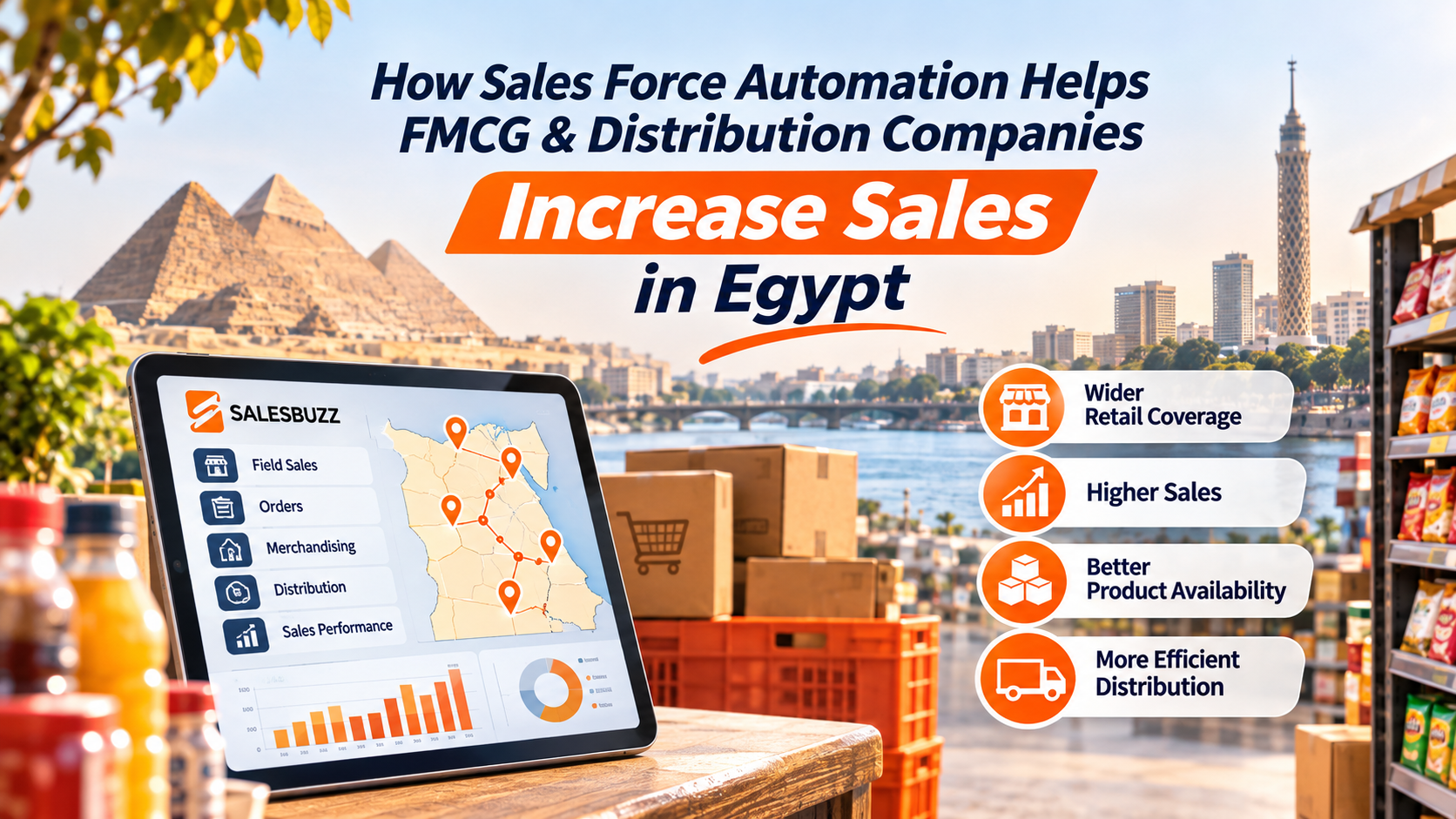
Egypt’s FMCG and distribution market is shaped by a broad mix of traditional grocery stores, supermarkets, hypermarkets, wholesalers, and regional distributors. Serving these channels efficiently requires more than a large sales team: companies need accurate customer information, well-planned field visits, reliable order processing, and close coordination between sales, warehouses, and delivery operations.
As businesses expand across Cairo, Giza, Alexandria, the Delta, and Upper Egypt, managing field activity through spreadsheets, phone calls, and paper-based orders can make it difficult to maintain consistent execution. Sales representatives may miss planned visits, managers may lack timely visibility into outlet performance, and stock or payment issues can take too long to reach the right team.
Sales Force Automation (SFA) helps address these challenges by connecting field sales activities through a central platform. It gives representatives practical tools for managing customer visits and orders, while providing supervisors and business leaders with clearer information to guide decisions and improve sales performance.
What Is Sales Force Automation?
Sales Force Automation is a technology solution that helps companies organise, monitor, and improve the activities of their field sales teams. Instead of relying on separate spreadsheets, handwritten orders, and repeated phone calls, businesses can manage key sales processes through one connected system.
An SFA platform typically supports customer database management, visit planning, GPS tracking, digital order collection, merchandising activities, sales targets, payment follow-up, and performance reporting.
For Egyptian FMCG and distribution companies, this is particularly useful because sales operations often involve thousands of outlets with different purchasing patterns. A neighbourhood grocery store in Giza, a supermarket in New Cairo, a wholesaler in Alexandria, and a retailer in Mansoura may all require different visit frequencies, product assortments, and sales approaches.
With SFA software, companies can organise these relationships more systematically and give managers a clearer view of what is happening across their distribution network.
10 Ways Sales Force Automation Helps FMCG and Distribution Companies Increase Sales in Egypt
1. Reach More Retail Outlets Across Egypt
Egypt’s grocery market includes a large base of independent neighbourhood stores alongside supermarkets, hypermarkets, and discount retailers. Reaching these different outlets requires a structured approach to customer management and territory allocation.
Sales Force Automation allows businesses to maintain an organised customer database, classify outlets by channel or location, and assign them to the appropriate sales representatives.
This helps companies identify underserved areas, reduce gaps in customer coverage, and build stronger relationships with retailers who may otherwise receive inconsistent visits.
By making the outlet network easier to manage, sales teams can identify additional opportunities and expand their market reach.
2. Improve Sales Coverage Across Governorates
Managing a sales operation in Egypt is different from serving customers in one city. Companies may have representatives covering Cairo and Giza while other teams serve Alexandria, the Delta, Canal cities, and Upper Egypt.
Without centralised monitoring, managers may struggle to understand whether territories are properly covered or whether some representatives are carrying an uneven workload.
SFA software helps divide territories, allocate customer accounts, and monitor field activity across locations. Supervisors can review completed visits, identify missed appointments, and assess the performance of individual regions.
This creates a more consistent sales operation, even when teams are distributed across multiple governorates.
3. Reduce Unproductive Travel and Missed Visits
Traffic congestion, long travel distances, and poorly organised daily schedules can reduce the number of productive customer visits a representative completes.
Sales Force Automation supports route planning by organising customer visits according to location, priority, and planned frequency. GPS tracking also gives supervisors visibility into field movement and visit completion.
Instead of spending valuable time deciding where to go next or travelling between distant customers unnecessarily, representatives can follow clearer daily plans.
Better route organisation helps sales teams make more effective use of their working hours and dedicate more time to customers.
4. Increase Order Opportunities at Every Customer Visit
A customer visit should be more than a routine check-in. It is an opportunity to understand purchasing needs, introduce relevant products, and encourage repeat orders.
With an SFA platform, representatives can access customer purchase histories, previous orders, product information, and account details while visiting an outlet.
This information helps them identify products a customer has not ordered recently, follow up on frequently purchased items, and recommend relevant additions to an order.
For FMCG companies managing large product portfolios, this can support better cross-selling and help representatives make more informed sales recommendations.
5. Improve Product Availability Across Retail Channels
Product availability is a major factor in FMCG sales performance. A retailer cannot sell products that are missing from its shelves, and repeated stock shortages may encourage customers to switch to competing brands.
Sales Force Automation helps representatives record stock observations during store visits, report unavailable products, and communicate replenishment requirements to the relevant teams.
Managers can review product availability across different outlets and identify recurring shortages by location, customer, or product category.
This information helps companies respond more quickly to distribution gaps and improve coordination between sales representatives, warehouses, and delivery teams.
6. Monitor Shelf Presence and Trade Promotions
In a competitive retail environment, securing shelf space is only part of the challenge. Companies also need to ensure that products are displayed correctly and promotional activities are implemented as planned.
An SFA solution with advanced merchandising capabilities allows field teams to record shelf conditions, product placement, promotional displays, and competitor activity.
Representatives can submit observations and photos from retail visits, giving supervisors a better understanding of how products are presented at the point of sale.
This is particularly valuable for companies supplying supermarkets, hypermarkets, discount retailers, and independent grocery stores, where merchandising requirements may vary considerably.
7. Process Orders Faster and Reduce Manual Errors
Paper-based order collection can create unnecessary delays between the sales representative and the back office. Handwritten quantities may be misread, product codes may be entered incorrectly, and orders may need repeated confirmation before processing.
SFA software enables representatives to capture orders digitally during customer visits using an organised product catalogue and customer information.
Orders can then be transferred to the relevant business processes according to the company’s system configuration.
This improves order accuracy, reduces repetitive administrative work, and helps the sales and operations teams handle customer requests more efficiently.
8. Coordinate Van Sales, Distribution, and Delivery Activities
Many FMCG businesses in Egypt depend on direct distribution and van sales to serve neighbourhood retailers and other customer segments.
These operations involve several connected activities: vehicle planning, available stock, customer orders, sales transactions, deliveries, and returns.
Sales Force Automation can support pre-sales and van sales processes while helping managers monitor field activity and coordinate orders with dispatch and delivery operations.
When sales and distribution information is connected, businesses can improve visibility over daily transactions and identify operational issues that may affect customer service.
9. Improve Collections and Control Outstanding Payments
Managing customer payments is an important part of maintaining healthy distribution operations. Sales teams often need to follow up on outstanding invoices, confirm received payments, and communicate account issues to finance teams.
An SFA solution can provide representatives with relevant customer account information and help managers monitor payment follow-ups through alerts and reports.
This makes it easier to identify overdue accounts, track collection activities, and prioritise customers who require attention.
For businesses dealing with different customer credit arrangements, better payment visibility can support more disciplined account management and reduce the risk of overlooked outstanding balances.
10. Make Better Sales Decisions Using Real-Time Information
Sales managers need more than end-of-month reports to understand how their teams are performing. They need timely information about customer visits, orders, sales targets, product movement, and territory activity.
SFA platforms provide dashboards and reports that bring these operational indicators together.
Management can compare sales performance across representatives, regions, customer categories, and product lines. They can also identify missed targets, declining customer activity, and areas where additional sales attention may be required.
With more reliable information available, businesses can adjust sales priorities, allocate resources more effectively, and make decisions based on actual field activity rather than assumptions.
How SalesBuzz Helps FMCG and Distribution Companies Grow Sales in Egypt
SalesBuzz by BI-Technologies is a Sales Force Automation solution designed to help FMCG and distribution businesses manage their field sales operations, improve customer coverage, and gain better visibility into daily performance.
Its capabilities support key activities across the sales and distribution cycle, including:
-
Pre-Sales and Van Sales: Manage different field selling models and support order collection and direct sales activities.
-
GPS Tracking: Monitor field representatives’ locations and improve visibility into customer visits.
-
Advanced Merchandising: Record shelf conditions, product placement, and promotional execution at retail outlets.
-
Dispatch and Delivery: Support coordination between sales orders, dispatch activities, and delivery operations.
-
Route Management: Organise daily routes and improve territory coverage.
-
Sales KPIs and Targets: Track individual and team performance against assigned objectives.
-
Commission and Compensation: Support the management of sales incentives and commission structures.
-
Power BI Dashboards: Turn sales and field activity data into reports that support management decisions.
-
E-Payment: Support electronic payment processes where suitable payment services and integrations are available.
-
Outstanding Invoice Alerts: Help sales teams follow up on overdue customer balances.
-
Route Targets for Wastage Returns: Support the monitoring of wastage and returns within field operations.
-
ERP Integration: Connect field sales processes with Microsoft Dynamics 365 ERP and other business systems, subject to the agreed integration scope.
By bringing these capabilities together, SalesBuzz helps companies create a more organised sales operation, improve coordination between field and office teams, and make better use of the information generated by everyday customer interactions.
Conclusion
Egypt’s FMCG and distribution market requires companies to manage a wide variety of retail customers, sales territories, product categories, and distribution activities. Maintaining consistent performance across this network becomes increasingly difficult when field operations depend on disconnected processes and limited reporting.
Sales Force Automation helps businesses move towards a more structured approach by improving outlet coverage, supporting representatives during customer visits, strengthening merchandising execution, and connecting sales activities with wider business operations.
For FMCG manufacturers, distributors, and consumer goods companies looking to improve their sales performance in Egypt, implementing an SFA solution can be an important step towards more efficient field operations and sustainable business growth.
Discover how SalesBuzz can support your sales and distribution operations.