



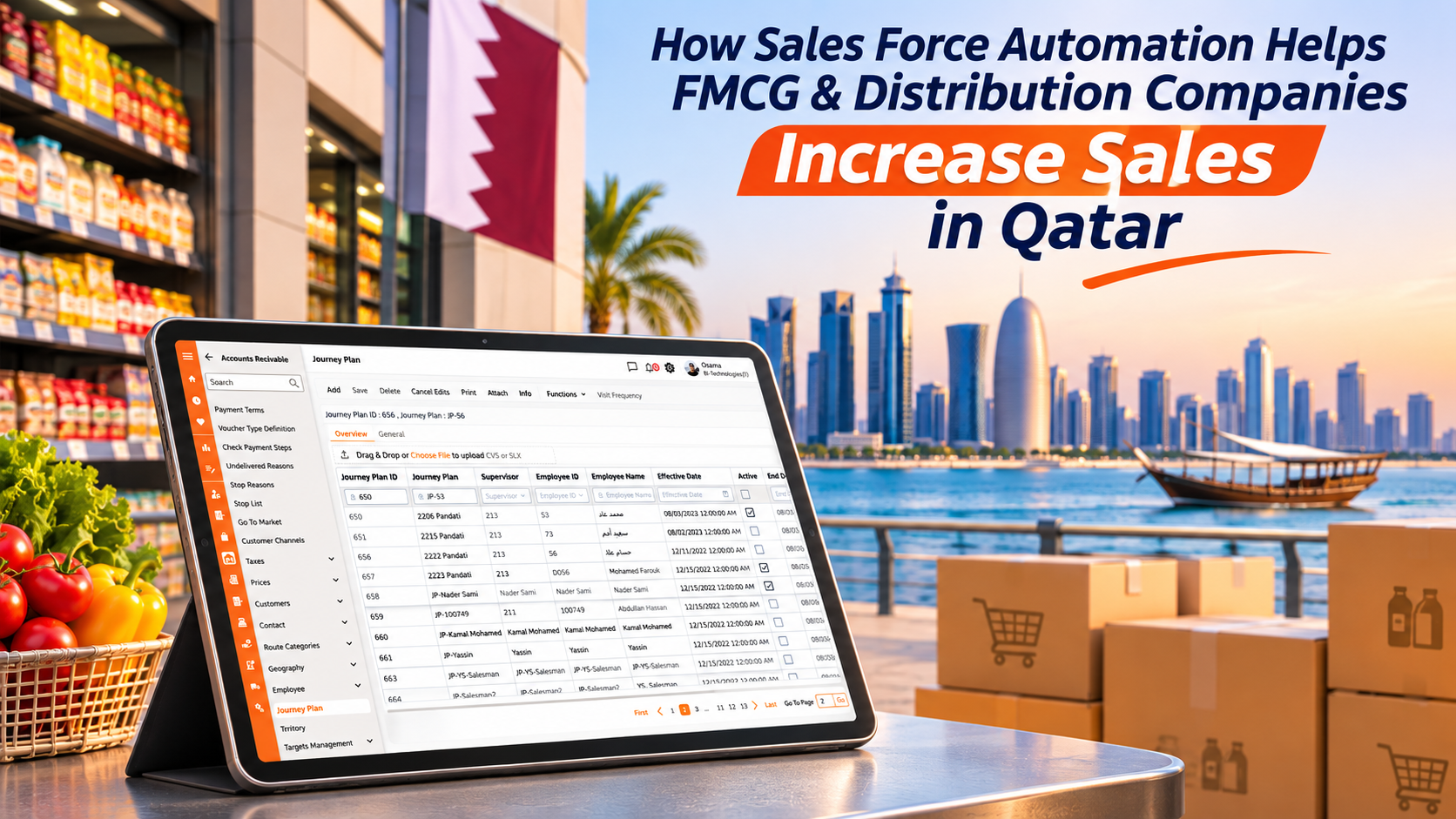
How Sales Force Automation Helps FMCG and Distribution Companies Increase Sales in Qatar
Introduction
Qatar’s FMCG market is shaped by a diverse retail environment, strong demand for consumer goods, and distribution networks serving supermarkets, hypermarkets, convenience stores, independent retailers, and the food-service sector. For manufacturers and distributors, competing successfully means ensuring that products reach the right outlets, orders are captured accurately, and sales teams respond quickly to changing customer needs.
Managing these activities across different channels can become challenging as businesses expand their customer base and product portfolios. Sales managers need reliable information about field activity, customer demand, product availability, and sales performance. Without connected systems, important opportunities can be missed because of inconsistent reporting, inefficient visit schedules, or delays between sales and distribution teams.
Sales Force Automation (SFA) helps address these challenges by connecting field representatives, supervisors, and back-office operations through a central platform. It gives businesses better control over daily sales activities and helps them turn market information into practical actions that support revenue growth.
In this article, we explore how Sales Force Automation helps FMCG and distribution companies increase sales in Qatar, improve field productivity, and build stronger customer relationships.
What Is Sales Force Automation?
Sales Force Automation is a technology solution that digitises and organises the activities performed by field sales teams. It helps businesses manage customer visits, sales orders, route planning, merchandising, collections, and performance monitoring through a connected system.
Rather than depending on paper-based reports, spreadsheets, and repeated phone communication, sales representatives can use mobile applications to access customer information, record transactions, and report field activities. Managers can monitor progress, review sales results, and identify operational issues through centralised dashboards.
For FMCG and distribution companies in Qatar, this is particularly useful when managing accounts across major retail chains, supermarkets, neighbourhood stores, wholesalers, and food-service customers. Each channel has different purchasing requirements and service expectations, making accurate customer information and coordinated field execution essential.
10 Ways Sales Force Automation Helps FMCG and Distribution Companies Increase Sales in Qatar
1. Turn Customer Data into More Sales Opportunities
A large customer database does not automatically translate into higher revenue. Businesses need to understand which customers are purchasing regularly, which accounts have growth potential, and where sales activity is falling behind.
SFA gives sales teams access to organised customer profiles, previous orders, purchasing patterns, and visit histories. Managers can use this information to segment accounts and identify customers who may benefit from additional product recommendations or more frequent visits.
For distributors serving Qatar’s modern retail sector alongside independent outlets, this makes it easier to identify opportunities across different customer categories instead of treating every account in the same way.
With better customer insights, sales teams can focus their efforts where they are most likely to generate additional revenue.
2. Improve Sales Coverage Across Qatar’s Retail Network
Reaching the right outlets consistently is a major part of FMCG sales growth. When territories are managed manually, some customers may receive unnecessary visits while others are overlooked.
Sales Force Automation helps businesses assign customer accounts to sales representatives, organise territories, and monitor outlet coverage. Supervisors can review completed and missed visits and identify areas where sales resources need to be adjusted.
This is valuable for companies serving customers across Doha, Al Rayyan, Al Wakrah, Lusail, and other commercial areas in Qatar. A more structured coverage plan helps distributors maintain regular contact with customers while expanding their reach into new locations.
The result is a more organised sales operation with fewer missed opportunities and better use of field resources.
3. Increase Representative Productivity Through Smarter Routes
Time spent travelling between customer locations directly affects how many productive visits a representative can complete.
Without proper route planning, sales teams may follow inefficient schedules, revisit nearby areas unnecessarily, or spend too much time coordinating their daily movements.
SFA supports route management by helping supervisors organise customer visits according to territory, priority, and planned schedules. GPS tracking can provide additional visibility into field movement and visit execution.
For distributors operating across Qatar’s growing urban and commercial areas, better route organisation can reduce unnecessary travel and allow representatives to dedicate more time to customer engagement and selling.
Improved productivity means sales teams can serve more customers without automatically increasing headcount.
4. Grow Revenue Through Cross-Selling and Product Recommendations
FMCG distributors often manage extensive product portfolios, but customers may purchase only a limited selection of the products available.
When representatives do not have easy access to customer purchasing history, they may miss opportunities to introduce complementary products, promote new items, or encourage customers to expand their regular orders.
An SFA platform gives representatives access to previous transactions and relevant customer information during visits. This helps them identify products that customers have not ordered recently and recommend suitable alternatives or additional items.
For example, a representative visiting a supermarket may identify opportunities to expand the range of beverages, snacks, dairy products, or household items supplied to that account.
More informed product recommendations can increase order value, improve product penetration, and support growth across existing customer relationships.
5. Reduce Out-of-Stock Situations and Protect Sales Revenue
Product availability is one of the most important factors influencing FMCG sales. When customers cannot find the products they need, distributors risk losing immediate orders and future purchasing opportunities.
Sales Force Automation helps field teams capture stock observations, report missing products, and identify outlets experiencing availability problems. These reports provide managers with better visibility into product distribution and replenishment requirements.
When connected with inventory and warehouse operations, field information can support more coordinated replenishment decisions and help businesses respond to stock issues faster.
For FMCG companies supplying supermarkets, convenience stores, and other retail outlets in Qatar, improved stock visibility helps protect sales opportunities and maintain more consistent product availability.
6. Strengthen Retail Execution and Promotional Campaigns
Sales growth is influenced not only by product availability but also by how effectively products are presented at the point of sale.
FMCG companies regularly compete for customer attention through shelf placement, promotional displays, product visibility, and in-store activities. Managing these activities across numerous outlets can be difficult without a consistent monitoring process.
SFA solutions with merchandising capabilities allow representatives to record shelf conditions, capture product display information, report missing items, and document promotional execution.
Sales supervisors can review these observations and identify outlets where agreed merchandising standards are not being maintained.
This gives businesses better control over retail execution and helps ensure that promotional investments are supported by effective implementation in the field.
7. Accelerate Order Processing and Improve Distribution Coordination
Delays between customer orders and delivery operations can affect customer satisfaction and create unnecessary pressure on distribution teams.
When orders are collected manually or communicated through disconnected channels, information may be incomplete or inaccurate. This can lead to processing delays, order discrepancies, and additional administrative work.
SFA enables representatives to capture orders digitally and submit them through structured workflows. Relevant order information can then be shared with back-office or ERP systems, depending on the integration setup.
For distributors managing large numbers of daily orders across Qatar, this improves information flow between field sales, order processing, warehouses, and delivery teams.
Faster and more accurate order handling helps businesses serve customers more reliably and reduce operational issues that can interrupt sales.
8. Improve Customer Retention Through Consistent Service
Winning new customers is important, but maintaining existing accounts is equally essential for sustainable revenue growth.
Retailers and wholesalers expect reliable communication, regular visits, accurate orders, and timely follow-up. When customer information is scattered across individual representatives or disconnected files, service quality can become inconsistent.
SFA centralises customer records, visit histories, previous orders, and relevant follow-up information. This allows authorised representatives and supervisors to maintain continuity even when account responsibilities change.
Sales managers can also identify customers who have reduced their purchasing activity or have not received their planned visits.
By making customer service more consistent and follow-up more organised, distributors can strengthen account relationships and encourage repeat business.
9. Control Outstanding Payments Without Disrupting Sales
Revenue growth must be supported by effective credit and collection management. Delayed payments can restrict cash flow and create difficulties when customers need to place additional orders.
Sales Force Automation helps field representatives access relevant invoice information, monitor outstanding balances, and follow up on overdue payments during customer visits.
Managers can use configurable alerts and reports to identify accounts requiring attention and coordinate follow-up between sales and finance teams.
For distributors working with numerous retail accounts and wholesalers, this improves visibility into customer payment behaviour and supports more structured collection activities.
Better payment follow-up helps protect cash flow while reducing the administrative burden associated with managing outstanding invoices.
10. Use Real-Time Sales Insights to Identify Growth Areas
Sales managers need more than total revenue figures to understand why performance changes across their business.
They need visibility into customer activity, territory results, representative productivity, order values, product performance, and visit completion.
SFA dashboards and reporting tools bring these indicators together, allowing management to evaluate results across different dimensions. Businesses can identify strong-performing territories, compare product demand, monitor sales targets, and investigate areas where results are below expectations.
For companies operating across multiple sales channels in Qatar, this information supports better decisions about territory allocation, sales priorities, and resource planning.
Instead of relying entirely on delayed reports, management can use more timely information to respond to market developments and pursue new revenue opportunities.
How SalesBuzz Helps FMCG and Distribution Companies Grow Sales in Qatar
SalesBuzz by BI-Technologies is a Sales Force Automation solution designed to help FMCG manufacturers and distributors manage field sales activities, improve execution, and gain better control over their distribution operations.
Its capabilities support the complete field sales process, from planning customer visits and capturing orders to monitoring performance and coordinating with other business functions.
Key capabilities include:
-
Pre-Sales and Van Sales: Manage field orders and direct selling activities through structured mobile workflows.
-
GPS Tracking: Monitor field representatives’ locations and gain visibility into sales team movement and visit execution.
-
Advanced Merchandising: Monitor product availability, shelf placement, and promotional execution at customer outlets.
-
Dispatch and Delivery: Improve coordination between sales orders and delivery operations.
-
Route Management: Organise customer visits and improve territory coverage.
-
Sales KPIs and Targets: Set performance objectives and monitor sales representatives’ achievements.
-
Commission and Compensation: Support sales incentive and commission management.
-
Power BI Dashboards: Analyse sales performance and access business insights through reporting dashboards.
-
E-Payment: Support configured electronic payment workflows.
-
Outstanding Invoice Alerts: Help sales teams follow up on overdue customer payments.
-
Route Targets for Wastage Returns: Monitor relevant return activities and support better field control.
-
ERP Integration: Connect field sales activities with ERP systems such as Microsoft Dynamics 365, subject to the agreed integration scope.
By bringing these capabilities together, SalesBuzz helps businesses improve the connection between field sales and distribution operations.
For FMCG and distribution companies in Qatar, this means more productive sales teams, better customer coverage, improved order accuracy, stronger retail execution, and greater visibility into the activities that influence revenue.
Conclusion
Increasing sales in Qatar’s FMCG and distribution market requires a coordinated approach to customer management, field execution, product availability, and operational efficiency.
From identifying new opportunities within existing accounts to improving retail coverage, managing promotional activities, and accelerating order processing, every stage of the sales process can influence business performance.
Sales Force Automation gives companies the tools to manage these activities through connected workflows, reliable field information, and better performance visibility.
With SalesBuzz, FMCG manufacturers and distributors can strengthen their sales operations, improve customer service, and make more informed decisions that support sustainable revenue growth.
Ready to improve your field sales performance and grow your distribution business in Qatar?
Discover how SalesBuzz can support your business.