



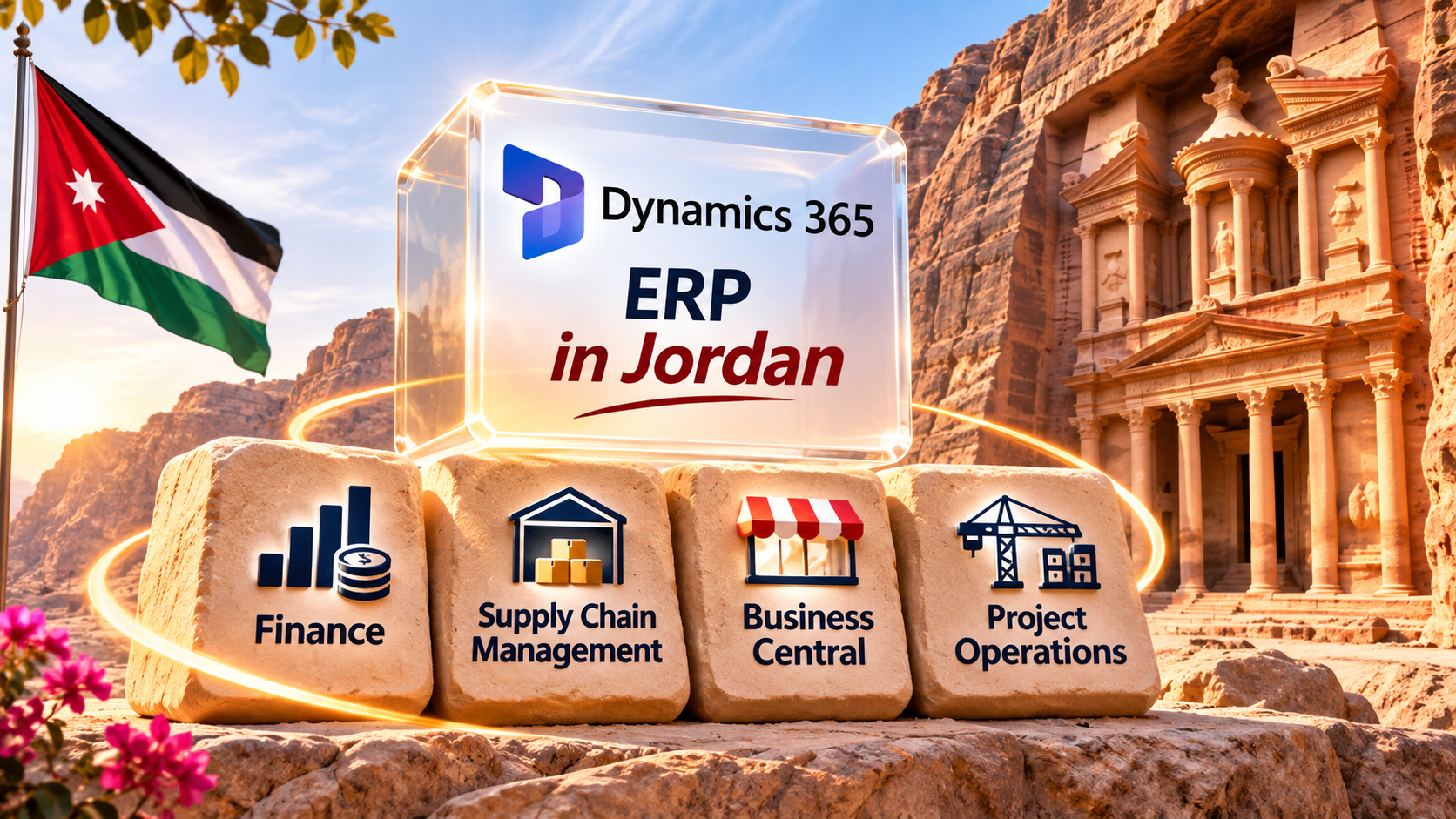
As businesses in Jordan expand their operations and compete in an increasingly connected regional market, managing finance, procurement, inventory, and projects through separate systems can become a significant obstacle to growth. Companies in trading, manufacturing, retail, construction, and professional services need accurate information and coordinated processes to manage their activities effectively.
For organisations operating across Amman, Zarqa, Irbid, Aqaba, and other markets, business complexity can increase further when they deal with multiple branches, international suppliers, different currencies, and regional customers. Disconnected applications and manual reporting can make it harder to monitor costs, control purchasing, and understand overall business performance.
Microsoft Dynamics 365 ERP provides a portfolio of business applications designed to connect these essential processes. By bringing financial and operational information into a more integrated environment, businesses can improve visibility, establish consistent workflows, and support better-informed decisions.
However, successful ERP implementation involves more than selecting a software platform. Companies need to identify the right applications, understand Jordan’s regulatory and business requirements, prepare existing data, and ensure the solution supports their actual operating model.
This guide explores the main Microsoft Dynamics 365 ERP solutions relevant to businesses in Jordan, the benefits they can deliver, and the key considerations for planning a successful implementation.
Top Microsoft Dynamics 365 ERP Solutions for Businesses in Jordan
The best ERP solution depends on the organisation’s structure, industry, and the processes it needs to improve. A growing distributor may focus on finance and stock management, while a large manufacturer may need more advanced supply chain capabilities. Engineering and consulting firms, on the other hand, may place greater emphasis on project planning and cost control.
Microsoft Dynamics 365 includes several applications that can be selected individually or combined to support these different requirements.
1. Microsoft Dynamics 365 Finance
For organisations managing complex accounting and financial operations
Microsoft Dynamics 365 Finance helps businesses manage general ledger, accounts payable and receivable, budgeting, cash flow, financial planning, and financial reporting.
For Jordanian companies with multiple branches, subsidiaries, or regional activities, the application can help establish more consistent financial processes and improve visibility across business units.
It is particularly relevant to organisations that handle transactions in different currencies, work with international suppliers, or need consolidated reporting across several legal entities.
During implementation, finance teams should define the chart of accounts, financial dimensions, reporting structure, approval workflows, and applicable tax treatments. These decisions provide the foundation for accurate financial information after go-live.
2. Microsoft Dynamics 365 Supply Chain Management
For businesses coordinating procurement, inventory, warehousing, and manufacturing
Microsoft Dynamics 365 Supply Chain Management helps organisations manage the flow of materials and products from suppliers through warehouses and production facilities to customers.
This application can be valuable for Jordanian manufacturers, distributors, retailers, and trading companies that manage imported goods, multiple storage locations, supplier relationships, or complex purchasing requirements.
Its capabilities include procurement, inventory management, warehouse operations, demand planning, production planning, and order fulfilment.
By connecting these activities, businesses can improve stock visibility, monitor purchasing commitments, and coordinate supply chain processes more effectively.
Implementation should account for warehouse locations, product data, supplier records, replenishment rules, inventory valuation, and the way purchasing and stock movements connect with financial operations.
3. Microsoft Dynamics 365 Business Central
For small and medium-sized businesses seeking an integrated management platform
Microsoft Dynamics 365 Business Central is designed to bring essential business functions together in one system.
It supports financial management, sales, purchasing, inventory, project costing, and reporting. For growing companies in Jordan that have reached the limits of spreadsheets or separate accounting and stock applications, Business Central can provide a more organised way to manage daily transactions.
It may be suitable for trading businesses, smaller distributors, service providers, and growing organisations that want stronger financial and operational control without the complexity of a large enterprise ERP environment.
The solution also supports integration with Microsoft 365 applications and can be extended through additional applications when business requirements call for them.
Microsoft Dynamics 365+1
4. Microsoft Dynamics 365 Project Operations
For construction, engineering, consulting, and project-based businesses
Microsoft Dynamics 365 Project Operations helps organisations manage the commercial and operational activities involved in delivering projects.
It connects project planning, sales, resource management, time and expense tracking, project costing, and financial processes.
This can be relevant to Jordanian contractors, engineering firms, professional services companies, and organisations delivering projects with defined budgets, schedules, resources, and customer agreements.
The application helps businesses monitor project progress and review the relationship between planned costs, actual expenses, resource utilisation, and financial performance.
For companies managing several contracts simultaneously, a structured project management environment can improve visibility and support more informed decisions.
Microsoft Learn+1
How to Choose the Right Dynamics 365 ERP Solution in Jordan
Selecting an ERP platform should start with an assessment of the organisation’s actual processes rather than a comparison of software features alone. Businesses should consider the following factors before deciding on the right application.
Business size and operational complexity
A growing company with straightforward finance, sales, and inventory requirements may find Business Central suitable. Organisations with several legal entities, extensive procurement, or complex warehouse operations may require Dynamics 365 Finance and Supply Chain Management.
Industry-specific workflows
Manufacturers, retailers, distributors, contractors, and service providers have different operational priorities. The ERP design should reflect the processes that have the greatest impact on each business, rather than forcing every department into a generic workflow.
Regional transactions and multiple currencies
Jordanian companies working with suppliers and customers across the GCC and wider international markets should assess how the solution will handle foreign-currency transactions, exchange rates, intercompany activities, and consolidated reporting.
Local regulatory requirements
Tax treatment, electronic invoicing, financial records, and personal data requirements should be reviewed during the initial assessment. The solution must be configured and tested against the rules applicable to the organisation.
Integration with existing systems
Businesses may need the ERP to exchange information with banks, HR and payroll applications, warehouse systems, point-of-sale solutions, e-commerce platforms, or CRM applications. Integration requirements should be documented before technical design begins.
Scalability and future expansion
The selected system should support realistic growth plans, including additional branches, warehouses, product categories, legal entities, and regional operations.
Key Benefits of Implementing Microsoft Dynamics 365 ERP in Jordan
When the right applications are configured around the organisation’s requirements, an ERP implementation can improve the way teams manage information, coordinate processes, and monitor performance.
1. Create a More Consistent Financial Picture
Connecting financial transactions and reporting in one environment helps management review business performance using more consistent information. Finance teams can reduce manual consolidation and improve visibility over income, expenses, cash positions, and outstanding balances.
2. Strengthen Procurement and Supplier Control
A connected purchasing process helps businesses monitor supplier records, purchase orders, approvals, and procurement commitments. This can be especially useful for organisations that depend on imported materials or work with suppliers across several markets.
3. Improve Inventory and Warehouse Management
Businesses can track stock across different warehouses and locations, review inventory movements, and coordinate replenishment with purchasing and sales teams. Better stock information can help reduce avoidable shortages and improve operational planning.
4. Establish Consistent Workflows Across Branches
Organisations with multiple branches or business units can introduce common procedures for purchasing, approvals, financial transactions, and reporting. Management can maintain an overall view while still reviewing the performance of individual locations.
5. Monitor Project Costs and Financial Performance
For contractors and project-based companies, connecting project activities with financial information helps managers review budgets, resource utilisation, expenses, and project profitability.
6. Improve Management Reporting and Business Visibility
Connected data can give decision-makers a broader view of financial and operational performance. Managers can review information more efficiently, identify issues, and make decisions based on more reliable business records.
7. Reduce Repetitive Administrative Processes
Automated workflows and connected applications can reduce manual data entry and repeated handovers between departments. This allows employees to spend less time reconciling information and more time managing their core responsibilities.
The results depend on the implementation scope, the quality of migrated data, appropriate configuration, and employee adoption.
Important Considerations Before ERP Implementation in Jordan
A successful ERP project must reflect the company’s local obligations and operational environment. Before implementation begins, businesses should review the following areas.
1. Prepare for JoFotara and Local E-Invoicing Requirements
Jordan’s National Electronic Invoicing System, commonly known as JoFotara, is an important consideration when designing finance and invoicing processes.
The Income and Sales Tax Department provides procedures for registering and issuing invoices through the national system. Businesses should assess how their ERP-generated invoices will be prepared, transmitted, and reconciled with the applicable e-invoicing requirements.
Income and Sales Tax Department+1
The implementation team should confirm the company’s registration status, applicable invoicing rules, required invoice fields, and technical integration approach with the relevant authorities or qualified local advisers.
It is important not to assume that standard Dynamics 365 functionality automatically provides complete JoFotara compliance. The required localisation, integration, or extension should be validated and tested before go-live.
2. Configure Financial and Tax Processes Correctly
Companies should review their accounting structure and applicable tax obligations before configuring the ERP.
This includes the chart of accounts, tax codes, financial dimensions, approval workflows, reporting requirements, and treatment of different transaction types.
Businesses operating across several markets should also distinguish between Jordanian requirements and the rules that apply to their other legal entities.
3. Address Personal Data and Information Security
ERP systems hold sensitive business information, including employee records, customer details, supplier information, and financial transactions.
Jordan’s Personal Data Protection Law No. 24 of 2023 makes data protection an important consideration for organisations handling personal information. Businesses should review access permissions, data collection, retention, processing arrangements, and the responsibilities of external service providers with qualified legal and compliance advisers.
The ERP project should include appropriate security roles, access controls, and procedures for protecting business information.
4. Define Multi-Currency and Regional Reporting Requirements
Many Jordanian companies work with international suppliers, regional customers, and operations in other GCC markets.
The ERP configuration should establish how foreign-currency transactions, exchange-rate differences, intercompany accounting, and consolidated reports will be handled.
Finance teams should agree on these policies early, as changes to financial structures after implementation can be difficult and disruptive.
5. Plan Banking and Third-Party Integrations
Organisations may need to connect Dynamics 365 with local banking services, payment providers, payroll platforms, warehouse systems, or other applications.
The project should identify which integrations are required, what information will be exchanged, how frequently synchronisation should occur, and how errors will be managed.
Each connection should be tested with the relevant provider to confirm that it works reliably in the company’s operating environment.
6. Clean and Validate Existing Business Data
Data migration is one of the most important stages of an ERP project.
Before transferring records, businesses should review customer and supplier databases, product catalogues, inventory balances, financial accounts, open invoices, purchase orders, and historical transactions.
Duplicated records, inconsistent product codes, and incomplete balances should be corrected before migration. This helps protect the accuracy of reports and reduces disruption after the new system goes live.
7. Choose an Experienced Implementation Partner and Prepare Employees
ERP implementation requires business analysis, solution design, configuration, integration, testing, training, and post-launch support.
Businesses should assess a partner’s experience with the selected Dynamics 365 applications, relevant industry processes, and local requirements.
Employee training should also be planned from the beginning. Finance, procurement, warehouse, sales, and project teams need role-specific guidance so they understand how the new processes affect their everyday responsibilities.
Microsoft Dynamics 365 ERP Implementation Examples in Jordan
Local implementation examples can help businesses understand how different Dynamics 365 applications may support specific operational requirements.
Jordanian Supermarket Chain – Dynamics 365 Business Central and LS Central
In January 2026, Novasoft announced the successful go-live of LS Central, built on Microsoft Dynamics 365 Business Central, for an established supermarket chain in Jordan.
The project focused on bringing retail activities together, including point-of-sale operations, inventory, supply chain processes, and financial management. It demonstrates how an integrated ERP environment can support retailers that need better coordination between store operations and back-office functions.
Novasoft KSA+1
George Abuzeid & Co. – Microsoft Dynamics AX
An earlier example is George Abuzeid & Co., which deployed Microsoft Dynamics AX 2012. The reported implementation supported integrated business processes, inventory optimisation, customer responsiveness, and business growth.
Although this is an older Dynamics AX implementation rather than a recent Dynamics 365 project, it provides an example of how ERP technology has been used by a Jordanian business to connect operational activities.
Jordan Vista
These examples illustrate that ERP requirements vary by industry. A supermarket may prioritise point-of-sale integration and stock visibility, while a trading or distribution company may focus on purchasing, financial control, and inventory management.
Jordan’s Business and Digital Transformation Context
Jordan’s business environment is placing increasing importance on structured digital processes and reliable electronic business records.
National Electronic Invoicing
JoFotara has become an important part of Jordan’s business digitalisation framework. The Income and Sales Tax Department’s procedures and guidance provide a reference for businesses assessing how invoicing systems should connect with the national platform.
Income and Sales Tax Department+1
For ERP projects, this makes invoice configuration, data accuracy, and integration planning important considerations from the early design stages.
Growth of Integrated Retail and Business Systems
The recent supermarket implementation using Business Central and LS Central illustrates how retailers can connect point-of-sale, inventory, supply chain, and financial operations through an integrated platform.
Novasoft KSA
Regional Business Connectivity
Jordanian businesses frequently work with suppliers, customers, and partners across the wider Middle East. This makes multi-currency processes, consolidated reporting, and consistent information-sharing particularly relevant when planning ERP architecture.
Together, these developments make it important for companies to evaluate not only the software they need today, but also how their ERP environment can adapt to changing regulatory requirements and future business expansion.
Conclusion
Implementing Microsoft Dynamics 365 ERP in Jordan can help organisations improve the way they manage finance, procurement, inventory, supply chain activities, and projects.
The appropriate solution depends on the company’s size, industry, existing systems, and future priorities. Business Central may be suitable for growing organisations seeking integrated core business management, while Dynamics 365 Finance and Supply Chain Management can address more complex enterprise requirements. Project Operations can provide additional capabilities for businesses managing project-based work.
However, successful implementation depends on more than selecting the right application. Companies must also prepare for JoFotara requirements, review data protection obligations, organise existing records, plan integrations, and train employees to work effectively with the new system.
With a clear implementation strategy and an experienced partner, Microsoft Dynamics 365 can help Jordanian businesses establish stronger operational control, improve management visibility, and build a technology foundation that supports sustainable growth.
Planning to implement Microsoft Dynamics 365 ERP in Jordan?
BI-Technologies can help assess your business requirements and explore the Microsoft business solutions that best fit your organisation.