



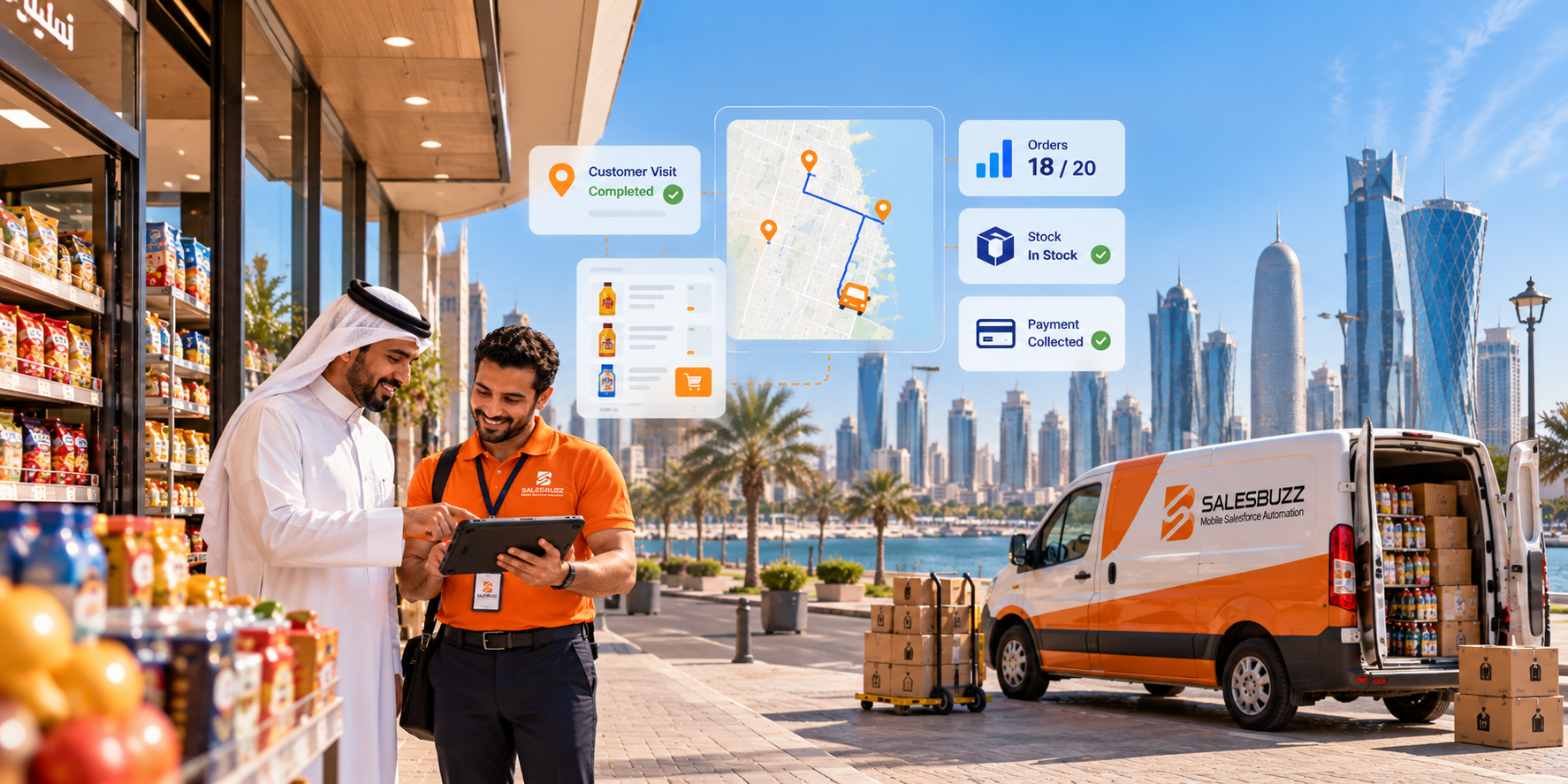
Introduction — The Reality of Field Sales in Qatar
Field sales in Qatar can be more complicated than the daily sales figures suggest.
A sales representative may start the morning with a planned list of customer visits, but things do not always go according to plan. A retailer requests a different order quantity, a product is unavailable, a delivery takes longer than expected, or a customer needs to follow up on an outstanding invoice. Multiply these situations across a sales team covering Doha and other parts of the country, and keeping everything organized becomes a real challenge.
For manufacturers, distributors and FMCG businesses, these everyday situations can affect sales productivity, customer satisfaction and the ability to meet targets.
Qatar is also investing in digital development through initiatives such as Qatar National Vision 2030 and the Digital Agenda 2030. These initiatives emphasize economic development, innovation and wider adoption of digital technologies. For field sales teams, however, digital transformation is not simply about replacing paper forms with mobile applications. It is about making everyday sales activities easier to manage and giving businesses better visibility into what is happening in the market.
That is where sales automation becomes useful.
What Is Sales Automation?
Put simply, sales automation uses software to handle repetitive tasks around selling, helping businesses manage their sales operations more efficiently.
Think about what a sales representative typically handles during a working day: customer visits, route planning, order taking, product availability, sales targets, payment collections and visit reports. When these activities depend on spreadsheets, paper documents, phone calls and separate systems, keeping information accurate and up to date takes considerable effort.
A Sales Force Automation (SFA) system brings these activities together in one platform.
A sales representative can use a mobile device to view planned visits, access customer information, check relevant product details and record orders directly at the outlet. Instead of writing an order on paper and entering it into another system later, the information can be captured while the representative is with the customer.
For supervisors and sales managers, the benefits are just as important. They can monitor field activity, review completed visits and follow sales performance without relying entirely on end-of-day reports.
The purpose is not to automate every part of the selling process. It is to reduce routine administrative work, improve the flow of information and give sales teams more time to focus on customers.
Where Field Sales Teams Lose Time
In Qatar, field sales operations can involve different types of customers, retail formats and distribution requirements. A business supplying supermarkets, groceries, convenience stores and other outlets needs to coordinate customer visits, orders, product availability and deliveries across its sales territories.
The challenges often begin with small operational issues.
A representative may spend too much time travelling between outlets because routes are not planned effectively. Another may arrive at a customer location without the information needed to confirm an order. Meanwhile, a sales supervisor might only discover later that planned visits were missed or a territory is falling behind its target.
Individually, these problems may seem manageable. Across a growing sales operation, however, they can affect productivity and make it harder to maintain consistent execution.
Some of the common challenges are:
- Limited field visibility: Managers may struggle to understand what is happening across their territories without waiting for representatives to report back.
- Inefficient route planning: Poorly organized customer journeys can increase travel time and reduce the number of productive visits completed each day.
- Unclear stock information: Sales representatives need reliable product information to manage customer expectations and capture orders accurately.
- Repeated order entry: Recording orders manually and entering them into another system creates extra work and increases the risk of errors.
- Inconsistent retail execution: Monitoring product availability, promotional displays and merchandising activities across multiple outlets can be difficult without structured field reporting.
- Payment collection challenges: Tracking outstanding invoices and customer payments becomes more complicated when information is spread across different systems.
- Delayed performance reporting: When sales data is collected manually, managers may identify missed opportunities or performance issues only after valuable time has passed.
As businesses expand their customer networks and distribution activities, these challenges become harder to manage through manual processes alone. A system that works for a small team may not provide the visibility and control needed by a larger operation.
How Sales Automation Helps Field Sales Teams
When field sales activities are connected through one system, businesses can manage daily operations with better visibility and less manual effort.
Representatives can start the day with planned customer visits and routes, then use a mobile application to record visits, access customer information and capture orders directly from the field. This reduces the need to transfer information between paper documents, spreadsheets and back-office systems.
For supervisors, it becomes easier to compare planned visits with actual activity, identify missed customers and understand how representatives are performing throughout the day. Route tracking can also help managers review how effectively territories are covered and where travel time may be affecting productivity.
Order management can become more straightforward as well. Representatives can record orders at the point of sale, helping reduce repeated data entry and improving the availability of information for the wider team. When the SFA system is integrated with inventory and ERP systems, it can also support better coordination between sales and back-office operations.
Payment visibility is another important consideration for distributors. By connecting field activities with relevant invoice and payment information, businesses can help representatives follow up on collections and give managers a clearer view of outstanding customer balances.
Retail execution also becomes easier to monitor. Representatives can record product availability, promotional compliance, shelf conditions and other store activities. Managers can then review what is happening at the point of sale instead of relying only on sales figures.
Performance monitoring becomes more useful, too. Rather than reviewing results only at the end of the month, managers can follow KPIs such as visit compliance, customer coverage, strike rate, average order value and target achievement throughout the sales cycle.
There is also an important distinction to make: automation does not replace the people behind the sales process. Representatives still need to build relationships, understand customer needs, negotiate orders and respond to unexpected situations. The software supports their work by making information easier to access and reducing the routine tasks surrounding each visit.
That gives sales teams more time to focus on customers and business opportunities.
What SalesBuzz Brings to the Field
SalesBuzz, developed by BI-Technologies, is a Sales Force Automation solution designed for businesses managing mobile sales teams and distribution operations. It connects sales representatives, supervisors and back-office teams through one platform, helping businesses maintain a shared view of field activity and sales performance.
For a typical field sales operation in Qatar, SalesBuzz can support:
- Route Planning & Tracking — plan customer journeys and monitor actual field activity to help improve route execution and territory coverage.
- Mobile Order Taking — capture customer orders directly from the field instead of relying on paper forms or later data entry.
- Customer Visit Management — schedule and record visits, monitor visit compliance and maintain better visibility into customer coverage.
- Retail Execution & Merchandising — monitor shelf availability, promotions, planograms and other in-store activities.
- Pre-Sales & Van Sales — support different selling and distribution models within the same sales operation.
- Sales KPIs & Targets — monitor key performance indicators and give managers a clearer view of target achievement.
- Digital Payments & Collections — support field payment processes and improve visibility into transactions and outstanding amounts.
- Dashboards & Analytics — turn daily sales activity into useful information for supervisors and decision-makers.
- ERP Integration — connect field sales activities with back-office systems, including Microsoft Dynamics 365 ERP, to support a more connected sales process.
For FMCG businesses, manufacturers and distributors operating in Qatar, these capabilities can help address everyday challenges across sales territories, customer networks and distribution channels.
By bringing key activities together, SalesBuzz helps businesses reduce manual work, improve field visibility and manage their sales operations with better information. The specific results depend on each organization’s processes, integrations and implementation requirements.
Conclusion — Better Sales Starts with Better Visibility
Field sales will always depend on people, relationships and the ability to respond to changing customer needs. No software can replace those elements, and it should not try to.
What sales automation can do is make the work surrounding those activities easier to manage.
With the right SFA system, representatives have access to relevant information when they visit customers, can capture orders more efficiently and can follow their daily plans with greater clarity. Meanwhile, managers gain a better view of field activity, customer coverage and sales performance across their territories.
For businesses in Qatar, this can mean fewer manual processes, better coordination between field and back-office teams, and more control over daily sales operations.
SalesBuzz brings these activities together in one platform, helping businesses manage field sales with less administrative work and better visibility.
Ready to Explore SalesBuzz?
Talk to the BI-Technologies team and discover how SalesBuzz can support your field sales and distribution operations in Qatar.
👉 Request a Demo: Ask for a demo – BI-Technologies