



Sales and distribution businesses in Syria operate in a market where maintaining customer relationships, managing product availability, and coordinating field activities are essential to business continuity. FMCG companies, wholesalers, and distributors often need to serve different types of retail outlets while managing changing supply conditions and sales requirements.
When field operations depend on paper-based reports, phone calls, and separate spreadsheets, managers may find it difficult to track customer visits, follow orders, monitor collections, and understand what is happening across different sales territories.
Sales Force Automation (SFA) provides a more organized way to manage these activities. By connecting field representatives with supervisors and back-office teams, an SFA platform can improve the flow of sales information and give businesses better control over their daily operations.
For companies in Syria looking to strengthen their distribution networks and prepare for changing market conditions, Sales Force Automation can support more consistent customer coverage, better field productivity, and more informed sales decisions.
What Is Sales Force Automation?
Sales Force Automation (SFA) is a digital solution that helps businesses manage the activities of sales representatives and field teams through a centralized platform.
It brings together processes such as customer visit scheduling, order collection, route planning, GPS tracking, merchandising, payment follow-up, and sales performance reporting. Instead of relying on manual records and delayed updates, representatives can capture information during customer visits and share it with management.
For Syrian businesses, SFA can be particularly valuable when coordinating sales activities across cities, managing wholesalers and independent retailers, monitoring stock availability, and maintaining visibility over customer orders and payments.
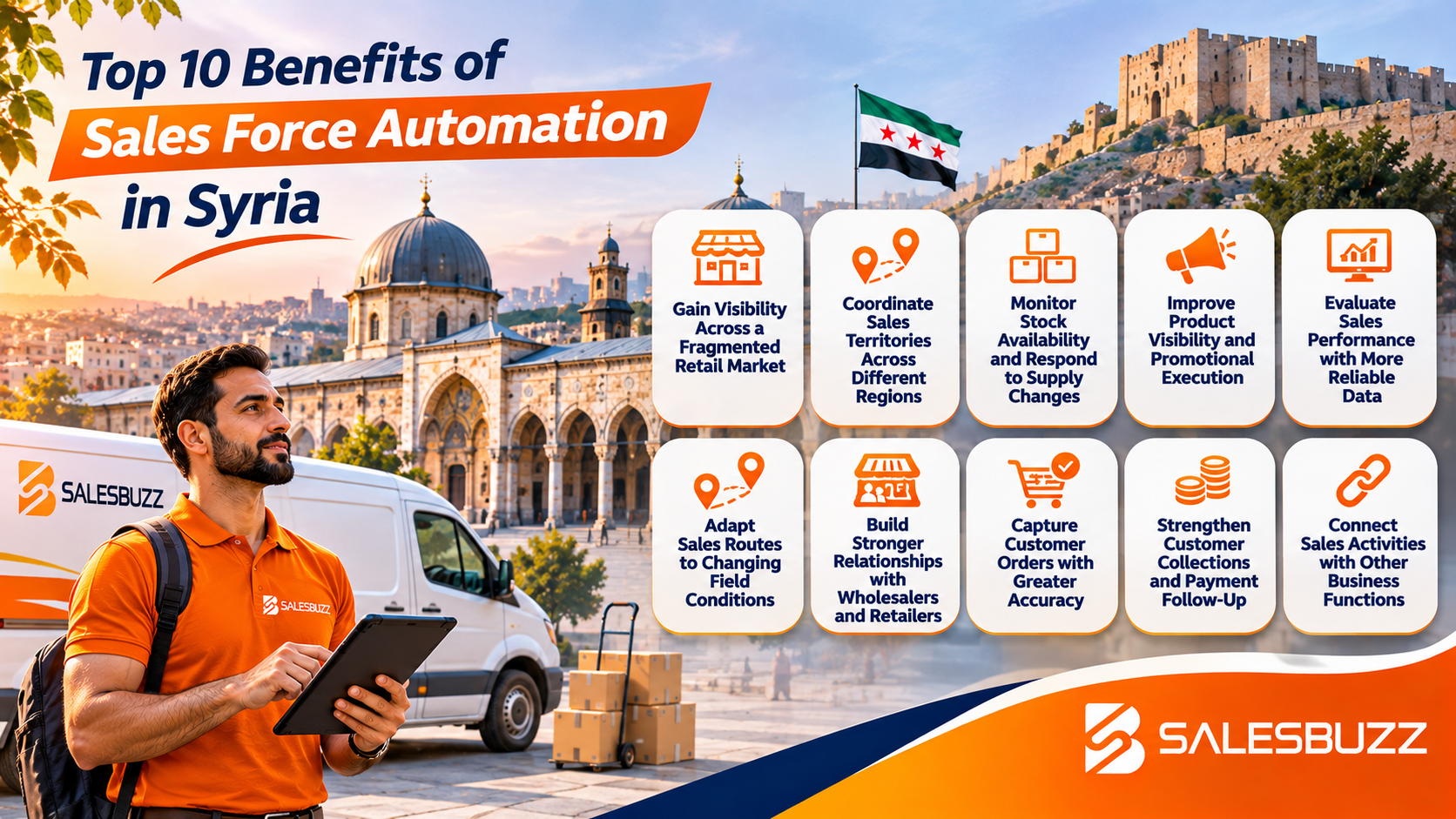
Top 10 Benefits of Sales Force Automation in Syria
1. Gain Visibility Across a Fragmented Retail Market
Syria’s retail environment includes independent shops, traditional markets, wholesalers, and smaller distributors operating alongside larger retail businesses. These outlets can have very different purchasing habits, order volumes, and service requirements.
For companies serving a broad customer base, keeping outlet information accurate and understanding sales activity across these different channels can be difficult.
Sales Force Automation gives businesses a centralized way to organize customer records and follow field activities.
With SFA, companies can:
-
Build a structured database of retail outlets and wholesale customers.
-
Classify accounts according to channel, location, and business potential.
-
Assign sales representatives to specific customer groups.
-
Review customer visit frequency and purchasing history.
-
Identify accounts that need additional sales attention.
This helps businesses maintain a clearer picture of their customer network and manage different retail channels more consistently.
Oxford Business Group+1
2. Coordinate Sales Territories Across Different Regions
Managing sales activities across Damascus, Aleppo, Homs, Hama, Latakia, and other commercial areas requires an organized approach to territory allocation.
When customer assignments and sales records are managed separately, companies may find it difficult to compare regional performance, identify coverage gaps, or distribute workloads effectively.
An SFA platform helps managers organize territories and connect customer information with representative assignments.
Businesses can use it to:
-
Allocate customer accounts by geographical area.
-
Define sales responsibilities for each representative.
-
Monitor activity across different cities and territories.
-
Compare regional sales results and customer coverage.
-
Identify areas that may offer opportunities for distribution expansion.
This gives management a more structured way to evaluate the reach of its sales network and allocate field resources.
3. Adapt Sales Routes to Changing Field Conditions
A representative’s daily schedule does not always go exactly as planned. Travel distances, delivery requirements, customer availability, and local operating conditions can affect the number of visits completed.
For businesses operating across different Syrian regions, route planning needs to consider more than simply arranging customer addresses in a list.
Sales Force Automation supports visit scheduling, route organization, and GPS-based field visibility, helping managers review planned activities against actual execution.
It can help companies:
-
Arrange daily visits according to customer location and priority.
-
Monitor representative locations through GPS tracking.
-
Review completed, missed, and delayed visits.
-
Reduce unnecessary travel between customer locations.
-
Adjust field assignments when schedules or operating conditions change.
Better route organization can help sales teams spend more time serving customers and less time managing their daily schedules.
4. Build Stronger Relationships with Wholesalers and Retailers
Wholesalers, independent merchants, and local distributors are important links in Syria’s product distribution network. Maintaining these relationships requires regular communication and a clear understanding of each customer’s purchasing needs.
Without an organized record of customer interactions, representatives may have limited access to previous orders, outstanding requirements, and follow-up commitments.
SFA software helps businesses maintain customer histories and record sales activities in one place.
It can support teams by helping them:
-
Maintain updated customer profiles and contact details.
-
Review previous orders and customer purchasing patterns.
-
Record discussions, requests, and follow-up actions.
-
Monitor the frequency of customer visits.
-
Identify customers whose purchasing activity has changed.
This makes customer interactions more consistent and helps sales managers identify accounts that require additional attention.
5. Monitor Stock Availability and Respond to Supply Changes
Product availability is particularly important in markets where purchasing conditions and supply flows can change. Businesses need to understand what is available at customer outlets, which products are running low, and where replenishment may be required.
In Syria, years of disruption affected supply chains and distribution networks, while the gradual reopening of trade and domestic value chains is creating new operational demands for businesses.
Oxford Business Group+1
Sales Force Automation can help field teams capture product and outlet information during customer visits.
Businesses can use it to:
-
Record product availability at retail locations.
-
Identify frequently unavailable products.
-
Report stock shortages directly from the field.
-
Monitor replenishment requirements.
-
Compare product availability across customer accounts and territories.
These insights help sales and distribution teams respond more effectively to stock issues and maintain better visibility into market demand.
6. Capture Customer Orders with Greater Accuracy
When representatives collect orders manually, details may be missed or recorded incorrectly. This can create additional work for office employees and delay the processing of customer requests.
A digital order management process allows representatives to record orders during customer visits and submit them through a more organized workflow.
Using SFA, businesses can:
-
Capture customer orders directly from the field.
-
Access product information and configured pricing.
-
Reduce errors associated with handwritten order forms.
-
Review order details before submission.
-
Improve communication between sales representatives and back-office teams.
For distributors handling multiple products and frequent customer orders, digital order collection can make the process easier to monitor and manage.
7. Improve Product Visibility and Promotional Execution
Maintaining a strong presence at retail outlets requires more than delivering products. Businesses also need to understand how products are displayed, whether promotional activities are implemented, and which outlets require additional attention.
For FMCG companies competing across traditional markets and retail stores in Syria, field observations can provide useful information about product placement and customer preferences.
SFA merchandising tools help representatives document what they see during store visits.
They can help businesses:
-
Record product placement and shelf availability.
-
Monitor promotional displays and merchandising activities.
-
Capture store photos and field observations.
-
Identify outlets with limited product visibility.
-
Follow up on merchandising requirements and corrective actions.
This gives sales supervisors a clearer view of retail execution without depending entirely on verbal updates from field teams.
8. Strengthen Customer Collections and Payment Follow-Up
Managing customer balances is an important part of distribution operations, particularly when businesses extend credit to wholesalers and retail customers.
In a market where cash continues to play a significant role in business transactions, keeping customer account information updated is important for effective collection management. The World Bank has also highlighted the need to modernize Syria’s financial infrastructure and expand more efficient digital payment services.
World Bank+1
An SFA solution can help connect field activities with customer account information and collection follow-up.
Businesses can use it to:
-
Review outstanding customer invoices.
-
Alert representatives to overdue balances.
-
Record payment and collection activities.
-
Monitor customer account status.
-
Improve coordination between sales and finance departments.
This helps businesses maintain better awareness of outstanding payments and organize collection responsibilities more effectively.
9. Evaluate Sales Performance with More Reliable Data
Sales figures alone do not explain everything about field team performance. Managers also need to understand how many customer visits are being completed, which territories are achieving their targets, and where representatives may need support.
Sales Force Automation centralizes field activity and sales information, making it easier to evaluate performance through reports and dashboards.
Businesses can monitor:
-
Sales results against individual and team targets.
-
Customer visit completion and frequency.
-
Order values and sales productivity.
-
Performance across territories and customer segments.
-
Product-level sales contribution.
-
Representative KPIs and field activity.
With access to more structured reporting, managers can identify trends, investigate performance gaps, and make decisions based on actual sales activity.
10. Connect Sales Activities with Other Business Functions
Field sales information is valuable to more than the sales department. Customer orders, product demand, payment updates, and market observations can all influence purchasing, inventory, warehouse operations, finance, and delivery planning.
When these departments work with disconnected information, it becomes harder to coordinate business activities and respond to customer requirements.
A connected SFA platform can help businesses share relevant sales data with other systems and operational teams.
This can support:
-
Better communication between sales and warehouse teams.
-
Improved visibility into customer orders and delivery requirements.
-
More useful field information for inventory planning.
-
Easier coordination between representatives and supervisors.
-
Integration with ERP platforms such as Microsoft Dynamics 365, depending on the agreed technical scope.
For Syrian businesses rebuilding and strengthening their distribution networks, better information flow between departments can support more coordinated operations.
What SalesBuzz Brings to Field Sales Teams in Syria
SalesBuzz by BI-Technologies is a Sales Force Automation solution designed to help FMCG companies, distributors, and businesses manage their field sales activities through connected digital tools.
It gives representatives, supervisors, and management teams access to information that supports customer visits, order collection, retail execution, and sales performance monitoring.
Key SalesBuzz capabilities include:
-
Pre-Sales and Van Sales: Manage different field sales models and capture customer orders.
-
GPS Tracking: Monitor representative locations and field activities.
-
Advanced Merchandising: Record product availability, shelf execution, and promotional activities.
-
Dispatch and Delivery: Support delivery coordination and order fulfillment processes.
-
Route Management: Organize customer visits and improve territory coverage.
-
Sales KPIs and Targets: Track individual and team performance against assigned objectives.
-
Commission and Compensation: Manage sales incentives and commission calculations.
-
Power BI Dashboards: Access sales reports and performance insights.
-
E-Payment: Support digital payment processes.
-
Outstanding Invoice Alerts: Help representatives identify overdue customer balances.
-
Route Targets for Wastage Returns: Monitor return-related targets within field operations.
-
ERP Integration: Connect sales activities with Microsoft Dynamics 365 ERP and other business systems according to integration requirements.
By bringing these capabilities together, SalesBuzz helps businesses improve field execution, organize distribution activities, and gain better visibility into sales operations.
Conclusion
Managing sales and distribution in Syria requires businesses to maintain close relationships with retailers and wholesalers, monitor product availability, and coordinate field teams across different locations.
Sales Force Automation provides a practical way to bring these activities together. From planning visits and collecting orders to monitoring merchandising, following up on payments, and measuring performance, SFA helps companies replace fragmented reporting with more organized sales processes.
For FMCG companies and distributors, the right SFA platform can improve field productivity, strengthen customer coverage, and provide management with more reliable information for decision-making.
With SalesBuzz, BI-Technologies helps businesses turn everyday field sales activities into more structured, measurable, and connected operations.
Ready to improve your field sales operations in Syria? Request a SalesBuzz demo.