



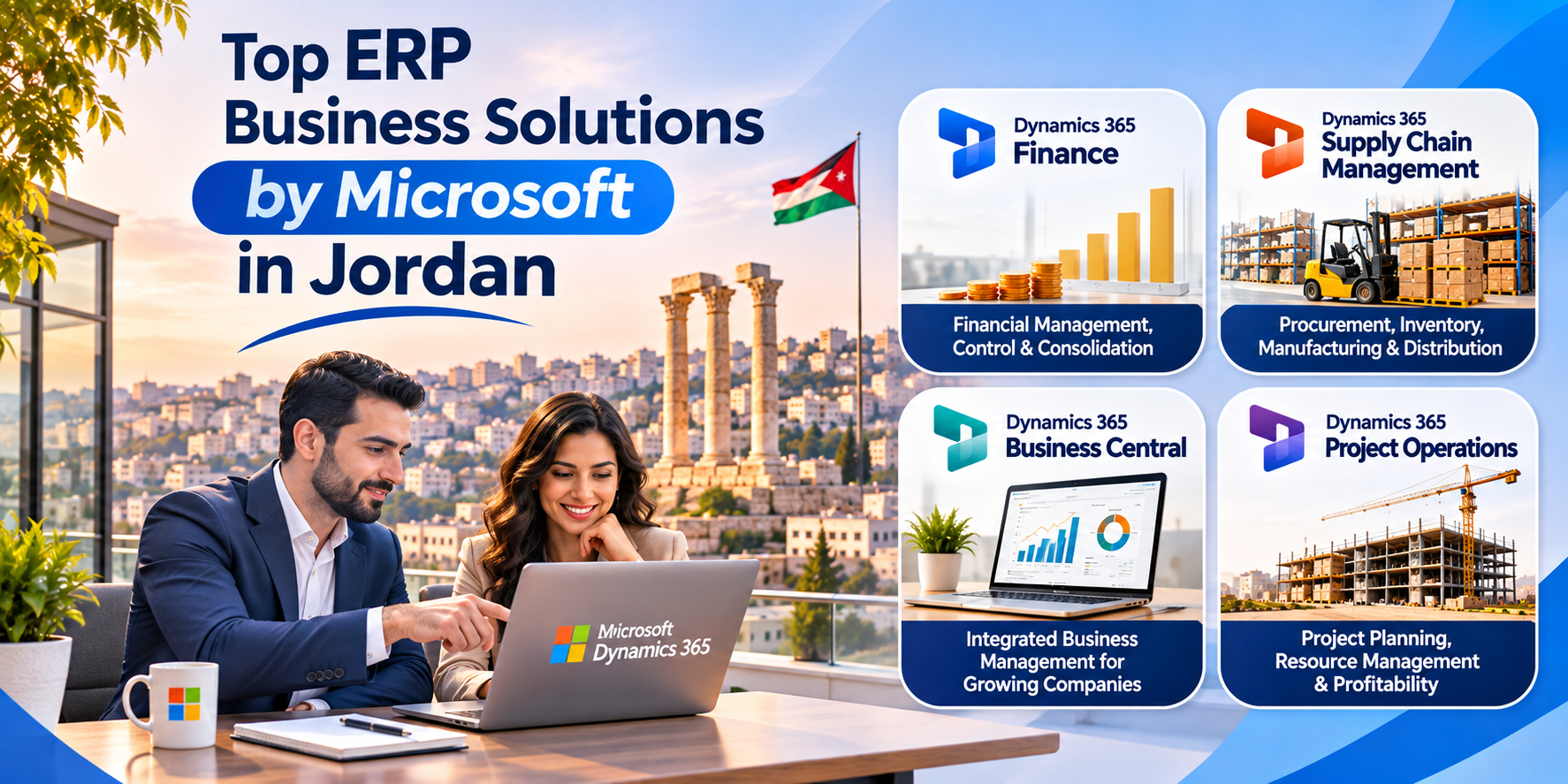
Businesses in Jordan operate across a wide range of sectors, from manufacturing and distribution to construction, retail, and professional services. As companies expand their operations, manage regional trade, or serve customers across multiple markets, keeping financial and operational information connected becomes increasingly important.
Relying on separate systems for accounting, purchasing, inventory, production, and project management can create reporting delays and make it harder for management teams to understand the full picture of business performance.
Microsoft Dynamics 365 offers a portfolio of ERP solutions designed to connect these business functions, improve process coordination, and support organizations at different stages of growth.
For companies in Jordan evaluating a new ERP system or planning to modernize existing operations, the right solution depends on their business model, operational complexity, and future expansion plans.
What Is Microsoft ERP Software?
Enterprise Resource Planning (ERP) software brings an organization’s main business processes together through a shared system of information. It helps departments work with consistent data instead of maintaining separate records across disconnected applications.
An ERP platform can connect financial management, procurement, inventory, sales, manufacturing, warehouse operations, and project activities. This allows businesses to coordinate workflows, monitor performance, and make decisions using more reliable information.
Microsoft Dynamics 365 provides different ERP applications to address these requirements. Companies can select the applications that fit their current needs and extend their technology environment as their operations develop.
For Jordanian businesses, ERP capabilities can be particularly useful when managing regional suppliers, multi-currency transactions, export activities, multiple warehouses, project contracts, and local financial and tax requirements.
Top 4 Microsoft ERP Business Solutions for Companies in Jordan
Microsoft Dynamics 365 includes several applications that serve different operational needs. The following four solutions are worth considering when evaluating ERP software for a business in Jordan.
1. Microsoft Dynamics 365 Finance
Best suited for: Large enterprises, holding companies, and organizations managing multiple entities or complex financial operations.
Microsoft Dynamics 365 Finance is designed to help organizations manage financial processes, improve internal controls, and gain a more complete understanding of their financial position.
For companies in Jordan with several branches, subsidiaries, or regional operations, consolidating financial information can become challenging when each business unit follows different procedures. Managing transactions in multiple currencies and preparing consistent reports across entities can add further complexity.
Dynamics 365 Finance supports core financial activities such as general ledger, accounts payable and receivable, budgeting, cash flow management, financial reporting, and financial planning.
It can help businesses:
-
Consolidate financial results across multiple legal entities.
-
Monitor budgets, expenses, cash flow, and financial performance.
-
Manage accounts payable, receivable, and payment processes.
-
Improve financial planning and reporting across departments.
-
Support multi-currency transactions and international business activities.
-
Configure tax and financial processes according to applicable local requirements.
For Jordanian organizations with complex financial structures or regional business activities, the solution can help establish more consistent financial processes and stronger management visibility.
Learn more: Microsoft Dynamics 365 Finance.
2. Microsoft Dynamics 365 Supply Chain Management
Best suited for: Manufacturers, distributors, importers, and businesses with demanding procurement and inventory requirements.
Managing a supply chain involves more than tracking stock. Businesses need to coordinate suppliers, purchasing, production, warehouse activities, and customer orders while responding to changes in demand and delivery schedules.
For Jordanian companies involved in manufacturing, importing, or regional distribution, these activities may span several suppliers, warehouses, and markets. Without connected operational information, teams can struggle to identify stock shortages, control purchasing costs, or plan production accurately.
Microsoft Dynamics 365 Supply Chain Management helps connect these processes through capabilities covering demand planning, procurement, inventory, warehouse management, production control, and order fulfillment.
Key business benefits include:
-
Improving visibility into stock levels across warehouses and locations.
-
Coordinating purchasing with production and customer demand.
-
Supporting demand forecasting and inventory replenishment.
-
Monitoring supplier performance and procurement activities.
-
Improving production scheduling and resource utilization.
-
Managing warehouse operations and order fulfillment more efficiently.
For manufacturing and distribution businesses in Jordan, these capabilities can support better coordination between procurement, production, inventory, and sales teams.
Learn more: Microsoft Dynamics 365 Supply Chain Management.
3. Microsoft Dynamics 365 Business Central
Best suited for: Small and medium-sized businesses looking to organize finance and daily operations within one ERP system.
Growing businesses often reach a point where basic accounting software and separate operational tools are no longer enough. Sales, purchasing, inventory, and financial information may be stored in different places, making it difficult to track performance or understand the impact of daily decisions.
Microsoft Dynamics 365 Business Central is designed to address this challenge by bringing core business functions together in one integrated ERP application.
For small and medium-sized companies in Jordan, it can provide a structured way to manage business growth without introducing the complexity of a large enterprise system.
Business Central includes capabilities for financial management, sales, purchasing, inventory, warehouse operations, and selected manufacturing and project management processes.
It can help growing businesses:
-
Connect financial and operational records.
-
Track sales, purchases, inventory, and supplier transactions.
-
Monitor cash flow, expenses, revenue, and profitability.
-
Improve coordination between sales, finance, and operations.
-
Support reporting and analysis through Microsoft ecosystem integrations.
-
Extend functionality as business requirements become more advanced.
For Jordanian SMEs moving beyond spreadsheets and standalone accounting applications, Business Central can offer a practical foundation for more connected business management.
Learn more: Microsoft Dynamics 365 Business Central.
4. Microsoft Dynamics 365 Project Operations
Best suited for: Construction companies, engineering consultancies, IT service providers, and project-based organizations.
For companies that deliver projects or contractual services, profitability depends on how effectively they manage resources, budgets, schedules, and project costs.
In Jordan, organizations operating in construction, engineering, technology, and professional services may handle several projects simultaneously, each with different customer requirements, delivery milestones, and resource needs. When project information is managed through disconnected spreadsheets and applications, monitoring progress and financial performance becomes more difficult.
Microsoft Dynamics 365 Project Operations connects project-related activities, from sales opportunities and resource planning to project execution, time tracking, expenses, and financial management.
Its capabilities can help organizations:
-
Prepare project estimates and customer quotations.
-
Allocate employees and resources according to project requirements.
-
Monitor budgets, delivery schedules, and project progress.
-
Track employee time, expenses, and project-related costs.
-
Improve communication between sales, project managers, and finance teams.
-
Evaluate project performance and profitability.
For Jordanian businesses that depend on delivering contracts and services, Project Operations can provide better oversight of project commitments and financial outcomes.
Learn more: Microsoft Dynamics 365 Project Operations.
How to Choose the Right Microsoft ERP Solution for Your Business in Jordan
Choosing an ERP system requires more than comparing software features. Businesses should first identify their operational priorities, current limitations, and plans for future growth.
The following considerations can help guide the selection process:
-
Financial management requirements: If your organization needs advanced budgeting, consolidated reporting, multi-entity accounting, and greater financial control, Dynamics 365 Finance may be the right option.
-
Supply chain complexity: If your business manages manufacturing, procurement, importing, warehouse operations, or distribution across different locations, Supply Chain Management may be more suitable.
-
Company size and operational needs: If you are an SME looking to connect accounting, sales, purchasing, and inventory, Business Central can provide an integrated solution.
-
Project delivery model: If your revenue depends on projects, contracts, and professional services, Project Operations can help manage resources, costs, and project performance.
Jordanian businesses should also assess local requirements before selecting and implementing an ERP system. These may include JoFotara e-invoicing requirements, applicable tax processes, financial reporting, Arabic and English documentation, and integrations with existing business applications. The required localization and configuration should be validated as part of the implementation assessment.
What Microsoft Dynamics 365 ERP Can Bring to Businesses in Jordan
Implementing an ERP solution is an opportunity to improve how different parts of an organization work together. When the system is selected and configured around actual business requirements, it can help companies establish more consistent processes and improve operational visibility.
For businesses in Jordan, Microsoft Dynamics 365 can support several important objectives:
-
More connected business operations: Bring financial, purchasing, inventory, and operational information into a coordinated environment.
-
Stronger financial oversight: Improve visibility into budgets, expenses, cash flow, and financial performance.
-
Improved supply chain coordination: Connect suppliers, procurement, inventory, production, and order fulfillment.
-
Better control of business processes: Standardize workflows and approvals across departments and locations.
-
More informed management decisions: Use consistent business information and reporting to identify performance issues and opportunities.
-
Support for regional expansion: Build an ERP environment that can accommodate additional entities, markets, and operational requirements as the business grows.
Jordan’s digital transformation agenda also highlights the importance of connected systems and more efficient business processes. The country’s Economic Modernisation Vision includes digital transformation initiatives, while the government continues to expand digital services and infrastructure. This creates a wider environment in which businesses are increasingly looking to improve how they manage information and operations.
Ministry of Digital Economy and Entrepreneurship+2
Microsoft Dynamics 365 ERP Implementation: What Should Businesses Consider?
Selecting the right ERP application is an important decision, but the quality of implementation has a major influence on the results. Businesses need to prepare their processes, data, teams, and technology environment before moving to a new system.
Before starting an ERP project in Jordan, organizations should consider the following:
-
Review existing business processes: Identify operational gaps, duplicated activities, and areas that depend heavily on manual work.
-
Establish clear requirements: Define the financial, operational, reporting, and industry-specific capabilities the business needs.
-
Validate local compliance requirements: Review JoFotara e-invoicing, tax configurations, and financial reporting requirements with the implementation partner.
-
Prepare business data: Clean and organize financial records, customer and supplier information, inventory data, and other records before migration.
-
Plan system integrations: Identify the applications that need to exchange information with the ERP, such as CRM, sales automation, warehouse, and reporting systems.
-
Prepare employees for the transition: Provide role-based training and support to help teams adopt the new workflows.
An effective implementation should reflect the way the organization operates and the improvements it wants to achieve. Simply transferring existing manual processes into a new system will not necessarily deliver the expected business value.
Conclusion
Microsoft Dynamics 365 provides a range of ERP solutions for businesses in Jordan, from growing SMEs to large organizations managing complex financial, manufacturing, distribution, and project operations.
Dynamics 365 Finance, Supply Chain Management, Business Central, and Project Operations address different business requirements. The right choice depends on the organization’s size, operating model, current challenges, and long-term objectives.
With a well-defined ERP strategy and the right implementation partner, Jordanian businesses can improve coordination between departments, strengthen operational control, and build a more reliable foundation for sustainable growth.
BI-Technologies helps businesses explore Microsoft Dynamics 365 ERP solutions and identify the right approach based on their operational requirements.
Ready to find the right ERP solution for your business? Request a demo.